It'd be nice to support importing (and exporting) of glTF 2.0 files.
Khronos just released the finalized glTF 2.0 Specification. For the most part, the syntax is changed so now properties are defined as arrays instead of objects/maps, with references defined as indexes instead of keys. The spec also defined PBR-based materials.
 dhritzkiv
All 40 comments
You are right, this would be great!
 kimkulling
on 12 Jun 2017
kimkulling
on 12 Jun 2017
I started a branch for this:
https://github.com/jamesgk/assimp/tree/gltf2-export
One issue for now is that, rather than duplicating most of the glTF 1 exporter, I modified it to export glTF 2. So on this branch it's no longer possible to export glTF 1. I also have not implemented glTF 2 importing.
 jamesgk
on 28 Jun 2017
jamesgk
on 28 Jun 2017
Sweet!
I think it'd be important to still support glTF v1, for legacy reasons, especially on import. I wonder if it'd be easy to sniff the version and then choose the right Parser/Importer.
The default version for glTF export should be v2, but v1 export might be specified via the format option: --format=gltf1
dhritzkiv
on 28 Jun 2017
@dhritzkiv is this in a working state?
 realvictorprm
on 17 Jul 2017
realvictorprm
on 17 Jul 2017
Hi @realvictorprm. I'm not working on this feature - I merely suggested it. See @jamesgk's work on glTF 2 support so far. It likely has some work to go before being integrated into assimp
dhritzkiv
on 17 Jul 2017
Yes, this definitely needs more work. I was just going to push some
fixes to animation exporting but then Daniel's suggestions still need
to be implemented.
jamesgk
on 17 Jul 2017
An update: on a new branch I separated glTF1 and 2 into two (largely duplicated) exporters, so now at least the glTF2 exporter should be mergeable: https://github.com/jamesgk/assimp/tree/gltf2.
jamesgk
on 26 Jul 2017
Thank you for your effort. I always appreciate open source work even if I'm not working mainly in the repo. If you need any help because you have no time don't hesitate to tell me.
realvictorprm
on 27 Jul 2017
@realvictorprm thanks! I probably won't have time in the near future to work on glTF 2 importing. So if there's much demand for that, any help would be welcome.
jamesgk
on 1 Aug 2017
FYI, glTF 2.0 seems to be the only future for glTF.
New tools being developed are already starting to favor 2.0, some even lacking 1.0 support entirely.
That said, yes, 1.0 and 2.0 would be ideal.
 jcowles
on 8 Sep 2017
jcowles
on 8 Sep 2017
Hi @jcowles. glTF2 export functionality is in assimp master, and there's some work from me to add glTF2 imports as well, here: #1423
dhritzkiv
on 8 Sep 2017
@dhritzkiv all of us working on the glTF spec are excited to see glTF 2.0 support in assimp! Is there any documentation on the extent of glTF 2.0 supported, roadmap, and anything Khronos can do to help?
 pjcozzi
on 16 Sep 2017
pjcozzi
on 16 Sep 2017
Thanks @pjcozzi!
In terms of assimp's support of glTF 2.0: much of the core parts of the spec are implemented:
- asset
- buffers
- except GLB - see below
- bufferViews
- scenes / scene
- nodes and meshes
~[update 2017-09-18] there's a PR fixing primitives output here: #1446~ - merged!
- images
- both via external uri and embedded base64-encoded data uris
- unsure about referencing via bufferViews. I think it's in there
- textures
- materials
- the basic properties, pbrMetallicRoughness and the pbrSpecularGlossiness extension are fully implemented.
- accessors, sort of - see next section
- I'm unsure about cameras support. I think it's in there.
What remains to be implemented/fixed is this functionality:
- binary_glTF
- I started work on it here a while ago, but I've not gotten far.
- animations/joints/skins/morph targets (and by extension, their accessors)
- assimp currently outputs some data for these, but it's copied from assimp's glTF 1.0 implementation, so it's incorrect
- sparse accessors
I didn't get around to fixing these, partly due to it not being a priority for my use cases, and partly because I'm unfamiliar with it.
Persisting name properties is a bit inconsistent, and extras properties also should be serialized and persisted.
glTF 2.0 extension implementations that are on the road map include:
- KHR_material_common/KHR_materials_cmnBlinnPhong
- lights
- Draco compression (to replace the now removed Open3DGC compression)
I think we'll wait until the extension specs are finalized before implementing these.
Speaking of KHR_material_common: several of us (in #1423) were unclear as to the state of KHR_material_common (or its equivalent) for glTF 2.0, partly due to to scattering of issues/PRs that address it, and the moving-target/ work-in-progress implementations in other loaders (namely three.js). As I understand it, the current plan is to implement a "common material" via KHR_materials_cmnBlinnPhong, yes? Is this the PR that we should be following: KhronosGroup/glTF#1075?
As for further help, it'd be appreciated if Khronos was able to verify the correctness of the export functionality (and import too, for that matter) of glTF 2 models. I tested against most of the models from the Khronos sample repo, and most pass the glTF validator with flying colours. The ones with animations/joints/skins/morphTargets present many errors.
If there's any interest from Khronos members in contributing further code and fixes, please do!
dhritzkiv
on 16 Sep 2017
Awesome.
However, testing master with a random glTF 2.0 file I grabbed from SketchFab, I'm getting a segfault with this stack:

jcowles
on 17 Sep 2017
Mind linking that model? I could try tracking the crash down
dhritzkiv
on 17 Sep 2017
jcowles
on 17 Sep 2017
I couldn't reproduce the crash on my end. Could it be platform dependent? I think there were some recently discovered issues with MSVC builds. (In which case, I'll let those with Windows experience address that) It could also be a general memory bug that might happen to surface on your machine.
That being said, the model didn't export perfectly: the tires, lights, and undercarriage are missing.
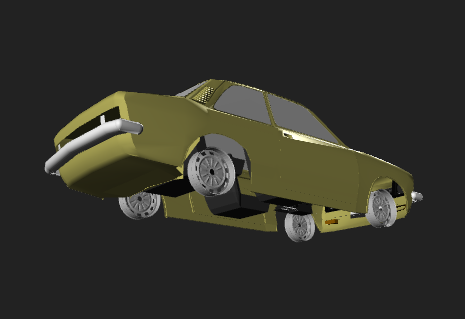
So, good test model (though, I have some simpler ones that might be easier to debug). I suspect that it may to do with having multiple primitives per mesh (a pretty glaring implementation omission on my part, if true).
dhritzkiv
on 17 Sep 2017
Well, it's odd that my glTF 1.0 and OBJ files load fine, but the new glTF 2.0 loader crashes.
Also, given that the MSVC run-time is killing the process, it definitely looks like a memory bug.
jcowles
on 17 Sep 2017
I'll try to take a crack at the memory bug on Monday when I'm at my workstation with better tools
dhritzkiv
on 17 Sep 2017
Alright, if I get inspired, I may take a look tonight too (doubtful though).
jcowles
on 17 Sep 2017
Also, the point at which it crashes is non-deterministic, if I run my script several times, it will crash with different stacks.
jcowles
on 17 Sep 2017
To to fully exclude my code, I tried this with assimp.exe and it also crashes.
jcowles
on 17 Sep 2017
Ok, one last bit of information, the assimp.exe validator crashes on this:
void ValidateDSProcess::Validate( const aiNode* pNode)
{
    if (!pNode)ReportError("A node of the scenegraph is NULL");
    if (pNode != mScene->mRootNode && !pNode->mParent)  // < Crash here on pNode->mParent
Looks like pNode is not equal to mRootNode and it's pointing at some illegal memory location (not null).
jcowles
on 17 Sep 2017
Your oversight comment above is exactly what's happening, in this code, it assumes exactly one primitive, allocates one mesh, but then proceeds to write multiple meshes, corrupting memory:
if (node.mesh) {
    ainode->mNumMeshes = 1;
    ainode->mMeshes = new unsigned int[1];

    int k = 0;
    int idx = node.mesh.GetIndex();

    for (unsigned int j = meshOffsets[idx]; j < meshOffsets[idx + 1]; ++j, ++k) {
        ainode->mMeshes[k] = j;
    }
}
In glTF, primitives are effectively draw calls, so it seems extremely common that meshes will have multiple primitives.
jcowles
on 17 Sep 2017
Got catch.
I've tracked it down to this commit: a0d97505e5a53a9aa3a734d6bd3ad790234e6e09
Reverting it works, however, now nodes reference multiple meshes with one primitive instead of one mesh with multiple primitives. Should be an easy fix, I think, though I don't quite know where to start. Probably in glTF2Exporter::ExportMeshes() or glTF2Exporter::ExportNodeHierarchy(). I'll take another look tomorrow.
dhritzkiv
on 17 Sep 2017
If primitives all have the same material and mode, they could be flattened into a single mesh, I think.
However, since Assimp doesn't support face material bindings, you must also support the code path where the material/pipeline state inst shared between primitives, which means having multiple meshes for a single node. This seems like a good starting point, since it has to be implemented as the fallback anyway.
jcowles
on 17 Sep 2017
Oh hey, the fix is easy:
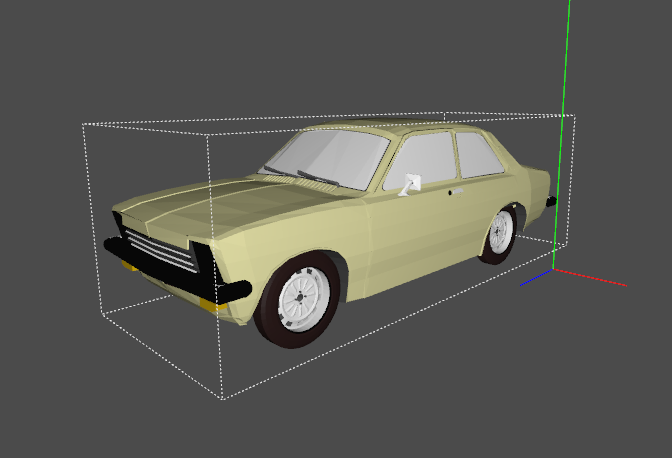
Should I send a PR?
jcowles
on 17 Sep 2017
@jcowles yes, please!
I've spent the last hour wracking my brain on how to flatten the meshes' primitives into a single mesh with multiple primitives, in code (I'm not too nimble with C++), so I'd love to see, and possibly use your solution.
dhritzkiv
on 17 Sep 2017
There you go!
jcowles
on 17 Sep 2017
Oh, hrm, it's also kind of a bummer that this implementation throws away all the glTF node names.
jcowles
on 17 Sep 2017
Wow, @dhritzkiv, thanks for all the details in https://github.com/assimp/assimp/issues/1301#issuecomment-329988412!
Speaking of KHR_material_common: several of us (in #1423) were unclear as to the state of KHR_material_common (or its equivalent) for glTF 2.0, partly due to to scattering of issues/PRs that address it, and the moving-target/ work-in-progress implementations in other loaders (namely three.js). As I understand it, the current plan is to implement a "common material" via KHR_materials_cmnBlinnPhong, yes? Is this the PR that we should be following: KhronosGroup/glTF#1075?
The plan is still to separate out lights and materials from the glTF 1.0 KHR_material_common extension.
As for the tweaks in https://github.com/KhronosGroup/glTF/pull/1075#issuecomment-328408375 and renaming KHR_materials_cmnBlinnPhong to KHR_materials_common, I do not know if this was confirmed.
@donmccurdy @UX3D-nopper do you know?
As for further help, it'd be appreciated if Khronos was able to verify the correctness of the export functionality (and import too, for that matter) of glTF 2 models.
I bet we can find some help. I will ask around!
If there's any interest from Khronos members in contributing further code and fixes, please do!
Nice, will also ask around!
pjcozzi
on 18 Sep 2017
as for ... renaming
KHR_materials_cmnBlinnPhongtoKHR_materials_common, I do not know if this was confirmed.
Not sure yet; I would hold off on implementing common materials a bit. Feedback on the issue is very welcome, though!
 donmccurdy
on 19 Sep 2017
donmccurdy
on 19 Sep 2017
Where can I try assimp gltf 2.0 importer? Because now I have error that no importer found for this format, where format is .gltf
 krupitskas
on 24 Nov 2017
krupitskas
on 24 Nov 2017
Are you using recent code from master on Github? The releases don’t include gltf 2 importing.
On Nov 24, 2017, at 07:02, Nikita Krupitskas notifications@github.com wrote:
Where can I try assimp gltf 2.0 importer? Because now I have error that no importer found for this format, where format is .gltf
—
You are receiving this because you were mentioned.
Reply to this email directly, view it on GitHub, or mute the thread.
dhritzkiv
on 24 Nov 2017
Yeah, Im fighting with this issue right now https://github.com/assimp/assimp/issues/1566
Thats why Im tried libassimp-dev and gltf not imported.
I just downloaded assimp and build it from sources, checked in asssimp_qt_viewer and everything works.
Do you know how to solve that problem?
Thanks
krupitskas
on 24 Nov 2017
Has it been released as a official release yet?
 mario-132
on 5 Feb 2018
mario-132
on 5 Feb 2018
This seems like a great feature! What can we do to make it happen!
 m0nologuer
on 13 Feb 2018
m0nologuer
on 13 Feb 2018
@Tim4135 @m0nologuer glTF importing and exporting is part of at least the 4.1.0 release. In addition, there have been more features and improvements to glTF2 features in the many commits since.
dhritzkiv
on 19 Feb 2018
Does external binary import glTF2 work? Do animations on glTF2 work at all right now?
 EvilPudding
on 30 Jun 2018
EvilPudding
on 30 Jun 2018
Is glb for glTF2.0 supported in current assimp version? Or is it expected to be supported in 5.0 release ?
 singhraj82
on 11 Sep 2019
singhraj82
on 11 Sep 2019
Related issues
 ctreffs
·
6Comments
krupitskas
·
3Comments
ctreffs
·
6Comments
krupitskas
·
3Comments
 junjiaokou
·
4Comments
junjiaokou
·
4Comments
 astrand130
·
6Comments
astrand130
·
6Comments
 dangelog
·
7Comments
dangelog
·
7Comments
Most helpful comment
Does external binary import glTF2 work? Do animations on glTF2 work at all right now?