Assertj-core: Consider adding isEven/isOdd to AbstractByteAssert, AbstractShortAssert, AbstractIntegerAssert and AbstractLongAssert
Summary
It is currently not possible to directly assert whether integers are odd or even.
Example
assertThat(someInteger).isEven();
assertThat(someInteger).isOdd();
 fbiville
All 14 comments
Wouldn't the isEven()/isOdd() pair be enough?
 scordio
on 17 Mar 2020
scordio
on 17 Mar 2020
yes, if it's not even then it's odd 😄
 joel-costigliola
on 17 Mar 2020
joel-costigliola
on 17 Mar 2020
Wouldn't the
isEven()/isOdd()pair be enough?
It could, but I imagine in some contexts, you want to express the negation. Maybe not worth keeping though. No strong opinions :)
fbiville
on 17 Mar 2020
It could, but I imagine in some contexts, you want to express the negation.
That would be odd! (sorry, I couldn't resist 😄)
scordio
on 17 Mar 2020
Let's keep it simple, no negative assertion.
joel-costigliola
on 17 Mar 2020
I assume we also want this for Byte, Short, Long and maybe even Character?
fbiville
on 18 Mar 2020
yes but I'm not sure we need it for character (how likely is somebody going to use that?), I'd rather wait for a user to ask for it
joel-costigliola
on 18 Mar 2020
I assume we also want this for Byte, Short, Long and maybe even Character?
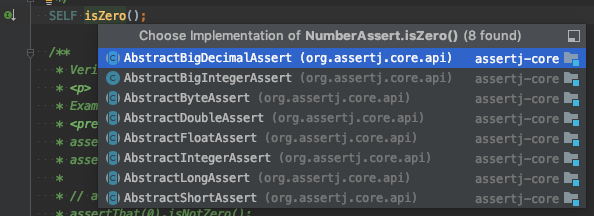
I think we should add these to NumberAssert, which would trigger some children classes so it's probably not going to be a small change.
I guess these new assertions should appear wherever isZero is available:
scordio
on 21 Mar 2020
The problem is that FloatingPointNumberAssert extends NumberAssert and you would end up with odd/even assertions for numbers other than integers.
fbiville
on 23 Mar 2020
Fair point, that would be wrong. Should we introduce an IntegerNumberAssert interface similarly to FloatingPointNumberAssert?
Probably BigInteger should also be part of the group, what do you think?
scordio
on 23 Mar 2020
Probably BigInteger should also be part of the group, what do you think?
yes but if that is too much work, happy to create another issue for that.
Should we introduce an IntegerNumberAssert interface similarly to FloatingPointNumberAssert?
no strong opinion on that
joel-costigliola
on 23 Mar 2020
We could go with the four in the title, later with BigInteger and then decide if the common interface is needed. For example, LongAdderAssert in #1812 could also belong to the family being a java.lang.Number.
scordio
on 24 Mar 2020
Fair point, that would be wrong. […]
Well, floating point number _can_ be integral (and even exactly so), so they can be odd or even. Only that many number are neither.
 piefel
on 27 Mar 2020
piefel
on 27 Mar 2020
Well, floating point number _can_ be integral (and even exactly so), so they can be odd or even. Only that many number are neither.
I'm far from being a mathematician, but the topic seems a bit more complicated when we move to rational numbers (i.e., floating point numbers), e.g. from Math StackExchange
The notion of parity can be extended to many rings - but certainly not all rings, since if 2 has an inverse 𝑢 then 2𝑢=1 ⇒2∣1∣𝑥 so everything is "even". So we can't extend it to all rationals, but if we restrict to the subring of rationals with odd denominator then integer parity has a unique extension: the parity of 𝑚/(2𝑛+1) is the parity of 𝑚, by mod2: (2𝑛+1)−1≡1−1≡1.
Also, from Wikipedia:
A fraction is even if the numerator is, therefore all rational numbers have parity.
IMHO I would keep floating point types out for now and we can always change it if the community sees the benefit of those assertions also there.
scordio
on 27 Mar 2020
Related issues
 hwielenberg
·
7Comments
hwielenberg
·
7Comments
 tarunmaganti
·
7Comments
tarunmaganti
·
7Comments
 tkruse
·
7Comments
joel-costigliola
·
5Comments
tkruse
·
7Comments
joel-costigliola
·
5Comments
 caugner
·
4Comments
caugner
·
4Comments
Most helpful comment
That would be odd! (sorry, I couldn't resist 😄)