Aspnetcore: Windows Authentication with Kestrel can ignore Authorization due to Middleware Order
Scenario:
- Using Windows Authentication with Kestrel (on Windows)
- Results in [Authorize] can pass through as an unauthorized request
( in certain situations)
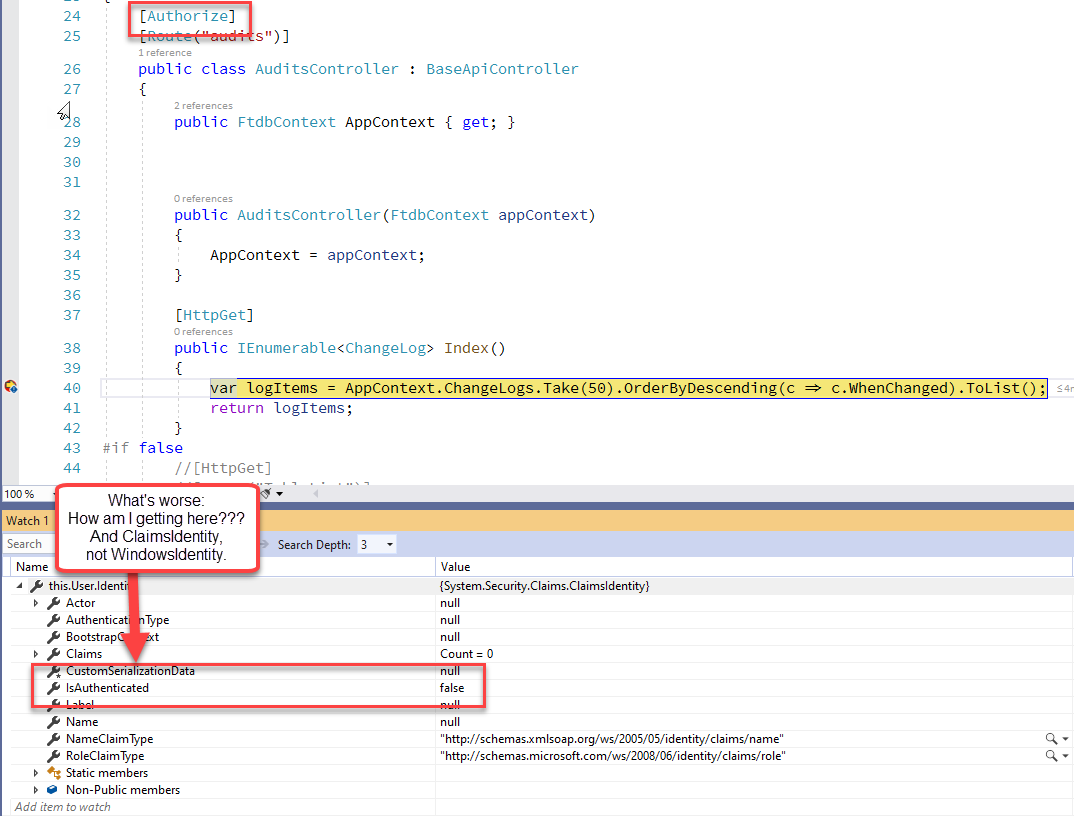
I ended up with this scenario after using IIS Express which worked fine to produce a Windows Identity object. Switching to Kestrel (on Windows) I got the result above.
There are two problems here:
- Context.User.Identity returns ClaimsIdentity instead of WindowsIdentity
- Context.User.Identiy.IsAuthenticated is false inside of a controller with
[Authorize]
After a Twitter discussion with Damien and Barry it turns out that this specific scenario was caused by a specific middleware order, but only on Kestrel. The same code below works when using IIS Express.
In ConfigureServices():
 services.AddAuthentication(NegotiateDefaults.AuthenticationScheme)
                                        .AddNegotiate();
In Configure():
            app.UseAuthentication();
            app.UseAuthorization();

            app.UseCors("CorsPolicy");


            // THIS IS THE PROBLEM - has to happen BEFORE .UseAuthorization
            app.UseRouting();

            app.UseEndpoints(endpoints =>
            {
                endpoints.MapControllers();
            });
Note .UseRouting() comes after .UseAuthorization() and .UseAuthentication() and that's what's apparently causing the non-authorization on the controller.
Switching the configuration code to:
            app.UseRouting();

            app.UseAuthentication();
            app.UseAuthorization();

            app.UseCors("CorsPolicy");


            app.UseEndpoints(endpoints =>
            {
                endpoints.MapControllers();
            });
makes the problem go away. WIth this in place both IIS Express and Kestrel now work with Windows Auth and produce a proper WindowsIdentity.
Expected Behavior
That the middleware order needs to be a certain way is understandable if confusing and non-discoverable, although it would be nice if there was some way to notify via error or warning if the order is not viable (if possible).
The more serious problem though is that the [Authorize] attribute on the controller in the failure scenario fails to block the request completely. Instead it passes through the request as if there was no authorization present at all. This should fail.
 RickStrahl
All 10 comments
@RickStrahl I can't reproduce the behavior where IIS Express provides an identity but Kestrel doesn't, when the order of the middleware is wrong. Can you share your launchSettings.json configuration for IIS/IIS Express please?
 DamianEdwards
on 17 Sep 2019
DamianEdwards
on 17 Sep 2019
I can reproduce the IIS Express behavior of always getting an identity (even when the middleware are in the wrong order) but only if I disable anonymous authentication. This essentially forces IIS Express to always authenticate so you always get an identity flowing from IIS Express.
DamianEdwards
on 17 Sep 2019
Somewhat related to #9041 and #8526
DamianEdwards
on 17 Sep 2019
@DamianEdwards - Double checked and the following is true:
- If I have
anonymousAuthentication=truein IISExpress Windows Auth works with the 'wrong' order - If I have
anonymousAuthentication=falseIISExpressWindows Auth doesn't work with the 'wrong' order and fails in the same way as the Kestrel
Swapping the order properly makes it work on all platforms.
RickStrahl
on 17 Sep 2019
Thanks @RickStrahl. To be clear, with IIS Express, when Windows authentication is enabled and anonymous disabled, it will always attempt to authenticate the user, irrespective of any challenge originating from the application. So while you may indeed end up with an identity being created, that doesn't mean the endpoint itself is being authorized if you get the middleware in the wrong order (i.e. the authentication, presence of an identity, and authorization of the endpoint, are all orthogonal).
We're looking at making a slight change to the current check we have to tighten this up and have the app throw an exception in the case that an endpoint with authorization metadata is to be executed, but the authorization middleware wasn't executed in the context of an endpoint being set. Today it just checks that the endpoint middleware executed anywhere in the pipeline, but that's not enough.
DamianEdwards
on 19 Sep 2019
This is patch worthy
 davidfowl
on 19 Sep 2019
davidfowl
on 19 Sep 2019
I have the same problem using Bearer token auth
public void Configure(IApplicationBuilder app)
{
            app.UseCors("corsGlobalPolicy");

            app.UseStaticFiles();
            app.UseHttpsRedirection();

            app.UseAuthentication();
            app.UseAuthorization();

            app.UseRouting(); // no auth active because this is after the UseAuth..,

            app.UseEndpoints(endpoints =>
            {
                endpoints.MapControllers();
            });
}
If I switch the UseRouting above the auth stuff, then the auth stuff works, otherwise all requests pass through.
 damienbod
on 19 Sep 2019
damienbod
on 19 Sep 2019
If I switch the UseRouting above the auth stuff, then the auth stuff works, otherwise all requests pass through.
That's by design but it should throw.
davidfowl
on 19 Sep 2019
@mkArtakMSFT are we in a position to prepare this as a patch for 3.0.x, rather than waiting for 3.1?
DamianEdwards
on 24 Sep 2019
@mkArtakMSFT are we in a position to prepare this as a patch for 3.0.x, rather than waiting for 3.1?
We'll be fixing this as part of 3.0.2 (November) release.
 mkArtakMSFT
on 3 Oct 2019
mkArtakMSFT
on 3 Oct 2019
Related issues
 bgribaudo
·
3Comments
bgribaudo
·
3Comments
 groogiam
·
3Comments
groogiam
·
3Comments
 farhadibehnam
·
3Comments
farhadibehnam
·
3Comments
 mj1856
·
3Comments
mj1856
·
3Comments
 FourLeafClover
·
3Comments
FourLeafClover
·
3Comments
Most helpful comment
That's by design but it should throw.