Arctos: Collecting Source (was for Paleo Collections)
I am moving this out of #1942
@ArctosDB/paleontology
I think we have determined that "wild caught" and "captive" are not appropriate collecting source terms for paleo collections.
Is everyone OK with the following?
found - discovered as part of a formal excavation or by serendipity and dug out from or removed from the surface of the Earth's crust
as well as adding the following establishment means attributes:
in situ - where deposited
ex situ - moved from place of deposition recently by gravity, water, other act of nature (float)
 Jegelewicz
All 45 comments
found - discovered as part of a formal excavation or by serendipity and dug out from or removed from the surface of the Earth's crust
this definition describes all archaeological collections as well so @sjshirar needs to weigh in if this is something they would use. I just wonder if this is even necessary... seems overly obvious for collections that by definition are either surface or subsurface finds? Maybe I'm missing something from the miles of comments on the preceding issue #1942?
 AJLinn
on 5 May 2019
AJLinn
on 5 May 2019
I find it acceptable.
Mary Beth
From: Teresa Mayfield-Meyer notifications@github.com
Sent: Saturday, May 4, 2019 6:59 PM
To: ArctosDB/arctos arctos@noreply.github.com
Cc: Prondzinski, Mary Beth mbprondzinski@ua.edu; Team mention team_mention@noreply.github.com
Subject: [ArctosDB/arctos] Collectin Source for Paleo Collections (#2070)
I am moving this out of #1942https://github.com/ArctosDB/arctos/issues/1942
@ArctosDB/paleontologyhttps://github.com/orgs/ArctosDB/teams/paleontology
I think we have determined that "wild caught" and "captive" are not appropriate collecting source terms for paleo collections.
Is everyone OK with the following?
found - discovered as part of a formal excavation or by serendipity and dug out from or removed from the surface of the Earth's crust
as well as adding the following establishment means attributes:
in situ - where deposited
ex situ - moved from place of deposition recently by gravity, water, other act of nature (float)
—
You are receiving this because you are on a team that was mentioned.
Reply to this email directly, view it on GitHubhttps://github.com/ArctosDB/arctos/issues/2070, or mute the threadhttps://github.com/notifications/unsubscribe-auth/AKJWLEEEXSNL4SQDXXRMDDLPTYPKXANCNFSM4HKZ7RAQ.
 mbprondzinski
on 6 May 2019
mbprondzinski
on 6 May 2019
I just wonder if this is even necessary... seems overly obvious for collections that by definition are either surface or subsurface finds? Maybe I'm missing something from the miles of comments on the preceding issue #1942?
It is either this or they have to use "wild caught" which doesn't seem appropriate.
Jegelewicz
on 6 May 2019
collections that by definition are either surface or subsurface finds?
I know nothing about that collection, but...
- found it on the surface, so a user might not want to use it in certain maps
- found it in situ (however they want to say that), so it's likely appropriate for anything the precision of the rest of the spatial data supports
- it's a replica or something, users will need to look at other stuff (parts, event type) to determine suitability for various maps
- it just magically appeared in the collection, users will need to look for other data
- etc.
All collections seem to have some "not quite what you'd expect" material of some sort; this is fundamentally just a way to sort that out, or maybe relieve users of the need to understand parts-and-stuff to determine suitability for use.
 dustymc
on 6 May 2019
dustymc
on 6 May 2019
What about just stating:
-surface
-sub-surface (then the attribute 'pit depth' would tell you how deep it was found)
it's a replica or something, users will need to look at other stuff (parts, event type) to determine suitability for various maps
This is part of issue #1020 which I'm not sure where we left... now we're talking about a part issue in the collecting source?
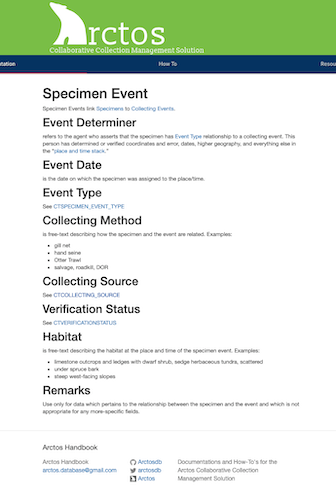
I guess part of my problem is that I don't clearly understand what people (both researchers and holding institutions) are supposed to get from this field, aside from the existing values.
There is no documentation for this field so how can we agree on what values should exist?
AJLinn
on 6 May 2019
-surface
-sub-surface
Works for me, although you'd need to clarify eg, how much has to be sticking out for something to be 'surface' in the definitions.
part issue in the collecting source
Given a 'manufacture' event (eg, you made a replica) of a manufactured object (you might want to record that event as well), this could (somehow...) help clarify - the place where the original was found is 'mappable,' the place where the replica was cast isn't (both for some purposes). I _think_ you could get all that from parts (at least if they're linked to Events), but this seems like a more straightforward way to record the purposes for which an event is suitable. Just thinking with my keyboard and trying to cover all the bases....
documentation
https://arctos.database.museum/info/ctDocumentation.cfm?table=CTCOLLECTING_SOURCE
don't clearly understand what people (both researchers and holding institutions) are supposed to get from this field
Me either. The original proposal was (I thought) intended to get at "probably about where it belongs" and "not that" (which is functionally what 'wild caught' vs. the rest do now, I think). I'm not 100% sure if the problem with the first proposal is the vocabulary or if there are some subtleties I'm not understanding. I think the latest proposal moves us away from 'wild caught' (which is just weird for lots of stuff) and still maintains first-pass capacity to get at things like "Is this suitable for this particular map?" (which can be refined via 'establishment means'). I don't think we've found a perfect solution - we certainly haven't found a universal one - but it does seem like a step in the right direction, and it should be an easy step to take.
dustymc
on 6 May 2019
I can see @AJLinn 's point and it makes me wonder if the "collecting source" field should just be "establishment means". If this were the case, the event would already provide a determiner and date so there would be no need to record them again along with an attribute.
Darwin Core Establishment Means Property:
Identifier | http://rs.tdwg.org/dwc/terms/establishmentMeans
Definition | The process by which the biological individual(s) represented in the Occurrence became established at the location.
Comments | Recommended best practice is to use a controlled vocabulary.
Examples | native, introduced, naturalised, invasive, managed
Jegelewicz
on 7 May 2019
"collecting source" field should just be "establishment means"
From a pure data modeling perspective, probably.
From the perspective of getting someone to use/understand it, I don't think so.
Say you have a whatever from wherever, and 40 opinions regarding invasive vs. cultured vs. introduced vs. etc. There's no disagreement over where the thing is or when it was collected, and no big-picture disagreement over how it got there, just the details are up for interpretation. With the details in the event, you'll end up with 40 dots on the map and 40 Occurrences in GBIF and etc. You need to find all 40 Occurrences in GBIF to get the full picture of _why_ there are 40 Occurrences. With the big picture in the event and the details in an Attribute, you'll end up with one dot, one Occurrence, and all of the details included in every (one in this case) record.
dustymc
on 7 May 2019
Yeah, see that point. So we need it to be an event attribute and I am OK with that. Now back to @AJLinn 's assertion - do we really need "collecting source"?
Jegelewicz
on 7 May 2019
do we really need "collecting source"
If you mean individually, https://github.com/ArctosDB/arctos/issues/1942#issuecomment-489680458 - there are currently two ways to not aassert anything. That's one too many, but I think we'll always have/need a 'we have no idea' option.
If you mean collectively, I think the alternative is people de-georeferencing things that don't fit in some arbitrary view of what should map. I'd interpret that as compelling evidence that we we do need the concept (and probably more tools to use it).
dustymc
on 7 May 2019
What about just stating:
-surface
-sub-surface (then the attribute 'pit depth' would tell you how deep it was found)
My preference, from a paleo perspective, is in-situ/ex-situ because something on the surface could still be in-situ (for example - fossils partially eroding out of exposed bedrock) and something in the subsurface could still be ex-situ (for example, a fossil that has been buried under a modern deposit). In-situ/ex-situ is actually an expert determination of the provenance of the specimen based on context clues - that determination is useful for deciding whether the data point is useful for describing ancient distributions, etc. Whereas surface vs. sub-surface is a single context clue that doesn't contain enough information to determine mapability.
 Nicole-Ridgwell-NMMNHS
on 14 May 2019
Nicole-Ridgwell-NMMNHS
on 14 May 2019
@AJLinn I can understand that this might be different for archaeological collections though, so maybe we need to find a compromise.
Nicole-Ridgwell-NMMNHS
on 14 May 2019
Based on what I've heard from @dustymc we can have both....
Jegelewicz
on 14 May 2019
I also prefer in-situ/ex-situ from paleo perspective. Having an unknown option is probably useful. I would think that most archaeological collections would be similar. Just add the connected option of surface/subsurface. It's all subsurface for paleontological data from cores.
I would say:
Found - discovered as part of a formal excavation or by serendipity.
Attributes: formal/informal (=serendipity)/unknown
Attributes values 1, 2,...: in-situ/ex-situ/surface/subsurface
Remarks: state context of in-situ/ex-situ/surface/subsurface
 dperriguey
on 14 May 2019
dperriguey
on 14 May 2019
Yes I think "do whatever in collecting source" is the compromise - bottom of https://github.com/ArctosDB/arctos/issues/1942#issuecomment-489273585.
expert determination
That's where the attribute could be useful - there can be any number of them, and they contain agents, dates, methods. Attributes are capable of carrying sufficient information to determine "mappability" (or determine that sufficient information doesn't exist, anyway!) for any purpose. Eg maybe you only want to map things with an establishmentmeans of BLA according to AGENT referencing publication DOI:xxxxx - attributes can carry that.
Having an unknown option is probably useful.
Agreed, but we currently have two of them: https://github.com/ArctosDB/arctos/issues/1942#issuecomment-489680458
dustymc
on 14 May 2019
OK, so given the above, I would add to COLLECTING_SOURCE:
found - discovered as part of a formal excavation or by serendipity
And these will end up in the "establishment means" attribute...
in situ - where deposited
ex situ - moved from place of deposition recently by gravity, water, other act of nature (float, drift)
surface - all or part of the object was visible without any excavation
sub-surface - the object could not be seen prior to excavation
Created a new issue for https://github.com/ArctosDB/arctos/issues/1942#issuecomment-489680458
Jegelewicz
on 14 May 2019
@sjshirar Can you please weigh in if this would work adequately for archaeological collections?
AJLinn
on 14 May 2019
We don't typically use the collecting source field as all of our contextual
data is captured in attributes, but as other archaeological repositories
start switching to Arctos I think these options should suffice.
On Tue, May 14, 2019 at 1:43 PM Angela Linn notifications@github.com
wrote:
@sjshirar https://github.com/sjshirar Can you please weigh in if this
would work adequately for archaeological collections?—
You are receiving this because you were mentioned.
Reply to this email directly, view it on GitHub
https://github.com/ArctosDB/arctos/issues/2070?email_source=notifications&email_token=AGWDEEOLJKVVLZSGM5OXE6DPVMW7VA5CNFSM4HKZ7RA2YY3PNVWWK3TUL52HS4DFVREXG43VMVBW63LNMVXHJKTDN5WW2ZLOORPWSZGODVM4ASQ#issuecomment-492421194,
or mute the thread
https://github.com/notifications/unsubscribe-auth/AGWDEEOXJRRAYAJ7GF5KV4TPVMW7VANCNFSM4HKZ7RAQ
.
--
Scott Shirar
Archaeology Collection Manager
University of Alaska Museum of the North
907-474-6943
 sjshirar
on 15 May 2019
sjshirar
on 15 May 2019
Reviving.
I think this is what is proposed here:
Add to COLLECTING_SOURCE code table: found - discovered as part of a formal excavation or by serendipity
Add to CTCOLL_EVENT_ATTR_TYPE: establishment means - The process by which the objects(s) represented in the collecting event became established at the location.
Add to CTCOLL_EVENT_ATT_ATT: for establishment means
in situ - where deposited
ex situ - moved from place of deposition recently by gravity, water, other act of nature (float, drift)
surface - all or part of the object was visible without any excavation
sub-surface - the object could not be seen prior to excavation
Jegelewicz
on 16 Oct 2019
That looks good to me.
Nicole-Ridgwell-NMMNHS
on 28 Oct 2019
@dperriguey @mbprondzinski are you guys good with this?
@dustymc thoughts? Can we do this so that NMMNH data goes in this way?
Jegelewicz
on 11 Feb 2020
Where's the distinction between "found" and "wild caught"? http://arctos.database.museum/info/ctDocumentation.cfm?table=CTCOLLECTING_SOURCE (So by our definitions 'found'==not captive - OK, but....)
I don't like your definitions, although I think I'm fine with the idea of them. 100% those will get used for non-paleo stuff, the definitions should cover that.
in situ: "In the original place;" a natural occurrence, including found where deposited or a species in its expected range
ex situ: "Not in the original place;" a unnatural occurrence, including paleontological float and invasive or introduced species.
surface - all or part of the object was visible above the natural surface
subsurface (don't think we need the hyphen) - Event occurred entirely beneath the local surface.
??
dustymc
on 11 Feb 2020
I can't say I have seen any of these attributes on any of the data sheets I've been handed. In other words, without the collector knowing these categories exist in the database, it won't be obvious to me after the fact.
mbprondzinski
on 11 Feb 2020
Where's the distinction between "found" and "wild caught"? http://arctos.database.museum/info/ctDocumentation.cfm?table=CTCOLLECTING_SOURCE (So by our definitions 'found'==not captive - OK, but....)
OK, but wild caught still seems super inappropriate for paleo (where we don't "catch" anything) and even more so for mineral specimens when we get to them. The definition of wild caught always seems to pertain to an animal
(of an animal) taken from the wild rather than bred from captive stock.
It just feels wrong every time I enter it for something that lived so far back in geologic time that I can barely comprehend the age.
Jegelewicz
on 11 Feb 2020
I can't say I have seen any of these attributes on any of the data sheets I've been handed. In other words, without the collector knowing these categories exist in the database, it won't be obvious to me after the fact.
There will be some collections who do not use the terms if they are not meaningful for them. I could go back and apply "ex-situ" to a bunch of shells in the UTEP invert collection that have the remark "float", which indicates the shells were transported to the location where they were collected by means other than the snails that lived in them.
Jegelewicz
on 11 Feb 2020
I know this has been hashed over and over, but why not just say "field collected"? That can pertain to "wild caught" or found or paleo, etc.
mbprondzinski
on 11 Feb 2020
The definition of wild caught always seems to pertain to an animal
Well Arctos Sybil had Mamm/Herp/Bird tables when it was introduced....
Can you use wild caught for now and open a dedicated issue to convert to a more neutral term? I think we're all trying to say the same thing, and I think synonyms are particularly evil here - eg, land managers will want lists of 'got there by itself' species.
dustymc
on 11 Feb 2020
Can you use wild caught for now and open a dedicated issue to convert to a more neutral term?
Sure - been doing that for a while now.
Still plan to add:
1 Add to CTCOLL_EVENT_ATTR_TYPE: establishment means - The process by which the objects(s) represented in the collecting event became established at the location.
- Add to CTCOLL_EVENT_ATT_ATT: for establishment means
in situ: "In the original place;" a natural occurrence, including found where deposited or a species in its expected range
ex situ: "Not in the original place;" a unnatural occurrence, such as paleontological float and invasive or introduced species.
surface - All or part of the object was visible above the natural surface.
subsurface - All of the object was entirely beneath the local surface.
Jegelewicz
on 11 Feb 2020
Fully agree with the original definitions of Teresa on Oct 15, 2019, and having the option of selecting in situ and ex situ would be great.
Wild caught applies to living organisms, but not to fossils. I support the other suggestions for fossils.
 aklompma
on 12 Feb 2020
aklompma
on 12 Feb 2020
Agree, and I like "field collected" as replacement for wild caught, which
is especially inappropriate for cultural collections.
On Tue, Feb 11, 2020, 9:41 PM Adiel Klompmaker notifications@github.com
wrote:
- UNM-IT Warning:* This message was sent from outside of the LoboMail
system. Do not click on links or open attachments unless you are sure the
content is safe. (2.3)Fully agree with the original definitions of Teresa on Oct 15, 2019, and
having the option of selecting in situ and ex situ would be great.Wild caught applies to living organisms, but not to fossils. I support the
other suggestions for fossils.—
You are receiving this because you are subscribed to this thread.
Reply to this email directly, view it on GitHub
https://github.com/ArctosDB/arctos/issues/2070?email_source=notifications&email_token=ADQ7JBAQHKNFEWDGSKBIWR3RCNOT7A5CNFSM4HKZ7RA2YY3PNVWWK3TUL52HS4DFVREXG43VMVBW63LNMVXHJKTDN5WW2ZLOORPWSZGOELPECKQ#issuecomment-584991018,
or unsubscribe
https://github.com/notifications/unsubscribe-auth/ADQ7JBETQ4TF22MXQRQODNTRCNOT7ANCNFSM4HKZ7RAQ
.
 campmlc
on 12 Feb 2020
campmlc
on 12 Feb 2020
Wild caught applies to living organisms, but not to fossils.
https://github.com/ArctosDB/arctos/issues/2494#issuecomment-585026889
"field collected"
That's a recipe for "field collected encountered" which isn't exactly clear. I'm fine with 'field' just not 'collected' - collection isn't the only thing that happens at events.
cultural collections
They have a more sophisticated approach to this, I can't imagine any scenario in which they'd care.
dustymc
on 12 Feb 2020
I'm not sure what this is all about, but "wild caught" isn't the only thing that happens at events, either. What exactly are we trying to convey?
mbprondzinski
on 12 Feb 2020
I believe that this field was meant to convey establishment means per Darwin Core but has since become code for "this thing was removed from where it was living its life naturally (and presumably killed by whoever did the removal either in that place or quite immediately thereafter)" or "this thing was propagated by or somehow maintained for a period of time by humans (thus it's stomach contents might not reflect its natural food or it may be more or less robust than its free-living relatives)".
To me it feels like we are trying to cram a bunch of information into a single term from which one can infer many things rather than just stating the facts. We should be more explicit which is why I want to set up the establishment means terms and just bypass the "collecting source", which for me doesn't convey any pertinent information. Since we are able to leave that field blank, I'll leave it to those who wish to use it to determine what should go there.
Jegelewicz
on 12 Feb 2020
What exactly are we trying to convey?
That's definitely a question for the paleontologists!
I believe we're mostly trying to salvage something from https://github.com/ArctosDB/arctos/issues/1942 at the moment, and not make critical things less-functional by eg denormalizing in the process.
For vertebrates, there are three kinds of events (collection, encounter, observation) and any of them can happen to critters which are or are not "valid for range map" (which we're spelling 'wild caught' for now). "Valid for range map" has been a mostly-subjective and not-very-fine-scale thing.
For cultural items, the "what was it doing THERE?!" information is built into the event type - it was being manufactured, used, or collected - and they have no obvious use for source.
I think the really weird paleo-thing involves float - "it came out of that rock RIGHT THERE, it's almost certainly fine for things like county-level checklists" and "it came from a flea market, probably died somewhere in China" seem to get dumped into the same bucket. (Introduced/cultivated/invasive etc. - DWC:establishmentMeans - is mostly similar, I think, but recording that level of specificity doesn't seem to be a pressing need for any existing collections.)
dustymc
on 12 Feb 2020
I think the really weird paleo-thing involves float - "it came out of that rock RIGHT THERE, it's almost certainly fine for things like county-level checklists" and "it came from a flea market, probably died somewhere in China" seem to get dumped into the same bucket.
I wouldn't say those things get thrown together. Ex-situ "float" is limited to stuff that has been moved naturally. I would only enter ex-situ or in-situ if the collector made that determination based on context. "it came from a flea market, probably died somewhere in China" (legal disclaimer, this is not actually something we would add to the collection) would be entered very differently, and establishment means would be left blank because we wouldn't have that data.
Nicole-Ridgwell-NMMNHS
on 18 Feb 2020
The point I was trying to get at is that I think we have three kinds of events:
- valid for range maps
- not valid for range maps
- mostly valid for range maps, but proceed with caution
https://arctos.database.museum/guid/UAM:ES:15127 claims to have fairly precise data, but also (in specimen remarks) claims to be float. SOME sort of "this specimen/locality relationship may not quite be what you expect" flag seems useful.
dustymc
on 18 Feb 2020
Is there some objection to replacing "wild caught" with "field"? I don't
see why we can't do that and proceed with #1692.
BTW, as has been discussed before, wild caught and field imply more than
just "mappable", they also contain info on usefulness of these samples for
dietary, ecological, and isotopic studies, for example. We cannot simply
replace with " in situ", which no one outside of paleo and archaeology
would necessarily understand. What else am I missing? What final decisions
need to be made here?
On Tue, Feb 18, 2020, 12:44 PM dustymc notifications@github.com wrote:
- UNM-IT Warning:* This message was sent from outside of the LoboMail
system. Do not click on links or open attachments unless you are sure the
content is safe. (2.3)The point I was trying to get at is that I think we have three kinds of
events:
- valid for range maps
- not valid for range maps
- mostly valid for range maps, but proceed with caution
https://arctos.database.museum/guid/UAM:ES:15127 claims to have fairly
precise data, but also (in specimen remarks) claims to be float. SOME sort
of "this specimen/locality relationship may not quite be what you expect"
flag seems useful.—
You are receiving this because you commented.
Reply to this email directly, view it on GitHub
https://github.com/ArctosDB/arctos/issues/2070?email_source=notifications&email_token=ADQ7JBEFGOH6QWXIPGQZ7L3RDQ3CLA5CNFSM4HKZ7RA2YY3PNVWWK3TUL52HS4DFVREXG43VMVBW63LNMVXHJKTDN5WW2ZLOORPWSZGOEMEAYAY#issuecomment-587729923,
or unsubscribe
https://github.com/notifications/unsubscribe-auth/ADQ7JBFDPJU2NOYKUEUKUMLRDQ3CLANCNFSM4HKZ7RAQ
.
campmlc
on 18 Feb 2020
What is holding us up from implementation of
https://github.com/ArctosDB/arctos/issues/1942?
On Tue, Feb 18, 2020, 1:26 PM Mariel Campbell campbell@carachupa.org
wrote:
Is there some objection to replacing "wild caught" with "field"? I don't
see why we can't do that and proceed with #1692.
BTW, as has been discussed before, wild caught and field imply more than
just "mappable", they also contain info on usefulness of these samples for
dietary, ecological, and isotopic studies, for example. We cannot simply
replace with " in situ", which no one outside of paleo and archaeology
would necessarily understand. What else am I missing? What final decisions
need to be made here?On Tue, Feb 18, 2020, 12:44 PM dustymc notifications@github.com wrote:
- UNM-IT Warning:* This message was sent from outside of the LoboMail
system. Do not click on links or open attachments unless you are sure the
content is safe. (2.3)The point I was trying to get at is that I think we have three kinds of
events:
- valid for range maps
- not valid for range maps
- mostly valid for range maps, but proceed with caution
https://arctos.database.museum/guid/UAM:ES:15127 claims to have fairly
precise data, but also (in specimen remarks) claims to be float. SOME sort
of "this specimen/locality relationship may not quite be what you expect"
flag seems useful.—
You are receiving this because you commented.
Reply to this email directly, view it on GitHub
https://github.com/ArctosDB/arctos/issues/2070?email_source=notifications&email_token=ADQ7JBEFGOH6QWXIPGQZ7L3RDQ3CLA5CNFSM4HKZ7RA2YY3PNVWWK3TUL52HS4DFVREXG43VMVBW63LNMVXHJKTDN5WW2ZLOORPWSZGOEMEAYAY#issuecomment-587729923,
or unsubscribe
https://github.com/notifications/unsubscribe-auth/ADQ7JBFDPJU2NOYKUEUKUMLRDQ3CLANCNFSM4HKZ7RAQ
.
campmlc
on 18 Feb 2020
This is so scattered, I can't find anything. Can someone round all of the collecting source issues up into one place?
objection to replacing "wild caught" with "field"?
https://github.com/ArctosDB/arctos/issues/2494#issuecomment-585311863
1942
I think @ewommack had some objection in some similar issue anyway, but I can't find it.
https://github.com/ArctosDB/arctos/issues/1942#issuecomment-491057736 needs resolved before we go very far.
dustymc
on 18 Feb 2020
Given #3084, and the new controlled vocabulary proposed for establishment means, I no longer think that establishment means is an appropriate place for in-situ, ex-situ, surface, and sub-surface.
Nicole-Ridgwell-NMMNHS
on 7 Oct 2020
@Nicole-Ridgwell-NMMNHS elaborate? I think it's the same sort of information, the suggested vocabulary just seems to be large-scale and modern-centric.
dustymc
on 8 Oct 2020
assuming the new definition is accepted, in situ and ex situ for fossils would not fit the new definition
statement about whether an organism or organisms have been introduced to a given place and time through the direct or indirect activity of modern humans
With fossils it is almost always erosion that that causes specimens to be ex-situ, not someone picking something up and moving it.
The new controlled vocabulary also makes it very clear that this is not where this kind of value belongs.
Nicole-Ridgwell-NMMNHS
on 8 Oct 2020
As far as I know there is no such thing as "controlled vocabulary" in DWC-land (seems fatal for an exchange standard!), I was viewing those as incomplete examples rather than anything like "thou shalt."
I'm also generally pretty happy to ignore things like "modern humans" in DWC "definitions" - I suppose I see that as a reflection of a limited viewpoint (eg, a botanist who never imagined they'd be sharing data with a paleontologist) rather than a limitation in how we should use the concept.
If those things are closer to "rules" than "very incomplete guidance" then I would still be in favor of implementing this as discussed, but perhaps not sharing it (or all of it, or something) via DWC. I could easily be convinced that we need a better name should we go that way.
Or maybe this is where @tucotuco pops in and exposes my ignorance, which often leads to happy places....
dustymc
on 8 Oct 2020
I'm not sure how rigorously we need to stick to the definitions. If there is a way to selectively not share anything with in situ or ex situ, etc. that might be good just so that someone getting this from an aggregator doesn't think 'this was moved by humans'. At TDWG ESP interest group meeting there was discussion on adding a new DWC term for these and other taphonomic data. ABCD EFG already has a term for this which is PostBurialTransportation.
Nicole-Ridgwell-NMMNHS
on 8 Oct 2020
My main interest here remains in usability, not necessarily in the details - but it would be cool if we can get a few birds with any stones we might cast. As above, I think we generally have three things to say:
- This is good for things like range maps
- This is not good for things like range maps
- This has some nuance, eg maybe it's fine for county-level rangemaps but not so much for fine-scale habitat or precise chrono-stuff, you're just going to have to look closer
dustymc
on 8 Oct 2020
Related issues
dustymc
·
4Comments
 acdoll
·
4Comments
acdoll
·
4Comments
 ccicero
·
8Comments
Jegelewicz
·
5Comments
ccicero
·
8Comments
Jegelewicz
·
5Comments
 sharpphyl
·
7Comments
sharpphyl
·
7Comments