Arangodb: Documentation: Fulltext index suggests multiple fields
My Environment
- __ArangoDB Version__: 3.3
- __Used Package__: ArangoDB PHP ODM
Component, Query & Data
__Affected feature__:
Fulltext index (documentation)
__Problem__:
The 'documentation' is inconsistent on whether a fulltext index can be created one or multiple attributes. By documentation I mean it in the broadest sense. The official docs and any place where information is provided about the fulltext index.
Below I've provided the three places where I noticed inconsistancies.
__Expected result__:
KISS: A consistent and factual description of the current state: 'what is'. Not 'what should be', 'what it will be' or 'what we want it to be'.
WebUI:
Steps to reproduce
1) Create or go to a collection
2) Create a new fulltext index
__Problem__:
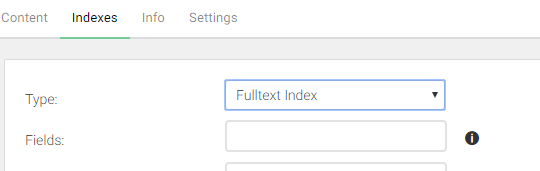
The WebUI fulltext label is 'Fields' (the help info is correct, but that is, ofcourse, hidden and requires an additional step before the information is available)
__Expected result__:
The label should just say 'Field' which makes it immediately obvious what is expected.
PHP ODM:
Steps to reproduce
1) open collectionHandler.php
2) Go to createFulltextIndex()
__Problem__:
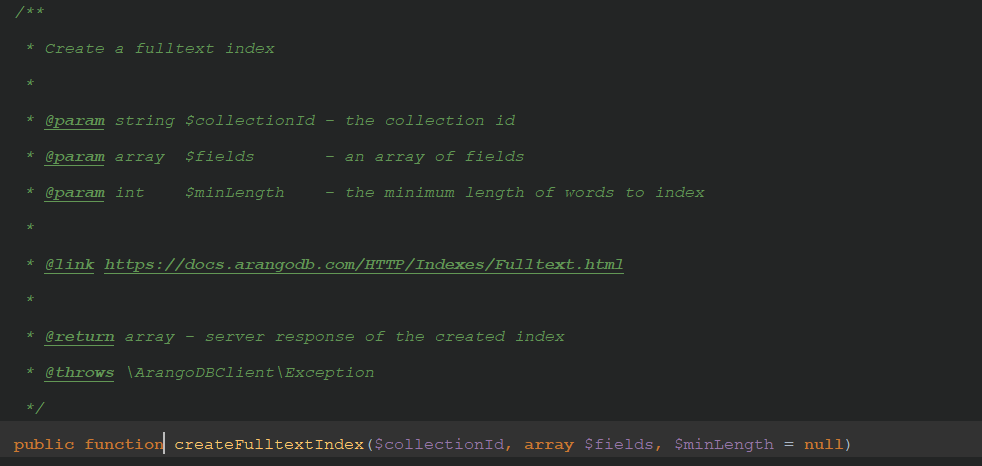
'...
* @param array $fields - an array of fields
...
public function createFulltextIndex($collectionId, array $fields, $minLength = null)
...etc...'
__Expected result__:
The second parameter should be 'string $field' etc
ArangoDB Documentation
Steps to reproduce
1) Go here: https://docs.arangodb.com/3.3/HTTP/Indexes/Fulltext.html
__Problem__:

'...
fields (string): an array of attribute names. Currently, the array is limited to exactly one attribute
....'
__Expected result__:
'...
field (string): the attribute name.
...'
 LaravelFreelancerNL
All 3 comments
the attribute named fields is the standard for all index types in arangodb, we are very unlikely to change that (sorry).
Perhaps you could submit a PR for the PHP driver documentation, if it bothers you ?
 graetzer
on 27 Nov 2018
graetzer
on 27 Nov 2018
The properties you can set on index creation in general are:
- type: hash, skiplist, fulltext, persistent, geo{1|2}
- fields: array of attribute names/paths to create the index over
- sparse: whether documents without the attribute or a _null_ value should be indexed
- unique: whether duplicate values are allowed
- deduplicate: if unique is true and this is an array index, then it controls if duplicate values within one array should be ignored or raise a unique constraint violation
Additional properties specific to one index type:
- minLength: minimum word length to index
- geoJson: whether GeoJSON order for latitude and longitude is used (up to 3.3) / if a GeoJSON object is stored (from 3.4.0 on)
The information might be a bit scattered, but it is documented that some of the properties have no meaning for certain index types and what values you should provide.
- Hash, skiplist and persistent indexes support all properties from the first list
- Geo and fulltext indexes are always sparse and never unique
- Fulltext indexes support the minLength property
- Geo indexes support one or two fields. You can store coordinates in an attribute as array like
[lat,lng]_(geoJson: false)_ or[lng,lat]_(geoJson: true)_ or as separate attributeslatandlng. - Fulltext indexes support a single field only:
A fulltext index can be defined on one attribute only, [...]
As @graetzer wrote, all indexes have a fields property and an array of strings is expected. Even if you want to index a single field only, it still has to be a string in an array. In case of fulltext indexes, there is a hard limit of one field. If you try to pass more than a single attribute path, an exception is raised:
ArangoError 10: bad parameter
The geo1 index expects one, geo2 two attribute paths. Otherwise they raise the same exception.
A general overhaul of the indexing chapter is on the to-do list, but not for this year.
 Simran-B
on 27 Nov 2018
Simran-B
on 27 Nov 2018
Thanks for the replies. And no it wasn't a bother, just an inconsistancy I noticed and thought to let you know.
LaravelFreelancerNL
on 6 Dec 2018
Related issues
 pekeler
·
4Comments
pekeler
·
4Comments
 dvzubarev
·
3Comments
dvzubarev
·
3Comments
 soualid
·
3Comments
soualid
·
3Comments
 caracal7
·
3Comments
caracal7
·
3Comments
 namnik
·
3Comments
namnik
·
3Comments
Most helpful comment
Thanks for the replies. And no it wasn't a bother, just an inconsistancy I noticed and thought to let you know.