Apollo: /apollo/sensors/gnss/imu coordinate?
Hi everyone:
I am confused about apollo's coordinate definition for IMU. From https://github.com/ApolloAuto/apollo/blob/master/docs/quickstart/apollo_2_0_hardware_system_installation_guide_v1.md#global-positioning-system-(gps)-and-inertial-measurement-unit-(imu), it looks like it uses right-front-up convention.
but when I played the demo_2_0.bag and did a "rostopic echo /apollo/sensor/gnss/imu", I found the output is:
header {
timestamp_sec: 1514497070.98
}
measurement_time: 1198532288.97
measurement_span: 0.00499999988824
linear_acceleration {
x: -0.406950712204
y: 0.759772956371
z: 9.945333004
}
angular_velocity {
x: 0.00417809403439
y: -0.0102860695989
z: 0.0226752302286
}
header {
timestamp_sec: 1514497070.99
}
measurement_time: 1198532288.97
measurement_span: 0.00499999988824
linear_acceleration {
x: -0.37208199501
y: 0.884849578142
z: 10.1518444717
}
angular_velocity {
x: -0.00308266097663
y: -0.0105845048871
z: 0.0220807003212
}
header {
timestamp_sec: 1514497070.99
}
measurement_time: 1198532288.98
measurement_span: 0.00499999988824
linear_acceleration {
x: -0.469535589218
y: 0.647213310003
z: 10.0661814213
}
angular_velocity {
x: -0.00666388443468
y: -0.0120485933008
z: 0.0225722407959
}
the linear acceleration tells that the z direction facing downward.
So, how the coordinate is defined from the message /apollo/sensors/gnss/imu?
Thanks
 yuconglin
All 7 comments
the Z's value is greater than zero, so the direction is toward up, why do you think the z direction is facing downward?
 xinwf
on 6 Sep 2018
xinwf
on 6 Sep 2018
The gravity acceleration is facing downward. Since the acceleration in z
direction is positive, I infer that z direction is same as the gravity
direction, which faces downward.
reference http://www.starlino.com/imu_guide.html
On Wed, Sep 5, 2018 at 9:58 PM 辛文飞 notifications@github.com wrote:
the Z's value is greater than zero, so the direction is toward up, why do
you think the z direction is facing downward?—
You are receiving this because you authored the thread.
Reply to this email directly, view it on GitHub
https://github.com/ApolloAuto/apollo/issues/5668#issuecomment-418938602,
or mute the thread
https://github.com/notifications/unsubscribe-auth/AGXu_B7fjKx3gvHBF3Xrc2hd9-FwqvYvks5uYIFXgaJpZM4WbxWp
.
yuconglin
on 6 Sep 2018
In apollo platform, the Z's positive direction is toward up, contrary to gravity, I think this document has a mistake when explaining the coordination. Have a look about it.
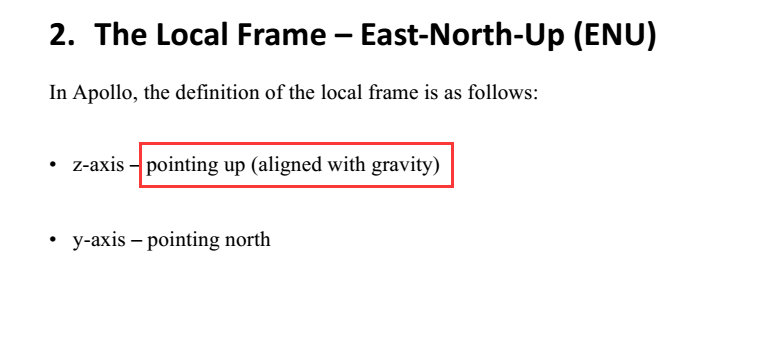
The description is ambiguous or a mistake. From the following explanation and other documents and apollo's codes you should know that the Z's positive direction is toward up. Not the direction of the gravity.
xinwf
on 6 Sep 2018
If z coordinate points up, and gravity points downward. Why do we have
positive gravity measurement? Measurement of acceleration is nothing more
than its projection on a coordinate frame.
On Thu, Sep 6, 2018 at 12:19 AM 辛文飞 notifications@github.com wrote:
In apollo platform, the Z's positive direction is toward up, contrary to
gravity, I think this document
https://github.com/ApolloAuto/apollo/blob/master/docs/specs/coordination.pdf
has a mistake when explaining the coordination. Have a look about it.
[image: qq 20180906121213]
https://user-images.githubusercontent.com/41889613/45134634-12b48580-b1ce-11e8-921d-2f0f8b496116.pngThe description is ambiguous or a mistake. From the following explanation
and other documents and apollo's codes you should know that the Z's
positive direction is toward up. Not the direction of the gravity.—
You are receiving this because you authored the thread.
Reply to this email directly, view it on GitHub
https://github.com/ApolloAuto/apollo/issues/5668#issuecomment-418959678,
or mute the thread
https://github.com/notifications/unsubscribe-auth/AGXu_E-AQiTS38jfsX6oTAPd-8c7LJ8Rks5uYKJagaJpZM4WbxWp
.
yuconglin
on 6 Sep 2018
If I may chime in, everything seems fine to me. Accelerometers do not measure the total acceleration but rather the specific force, that is (over simplifying) the acceleration minus the gravitational acceleration.
This means that an accelerometer in free fall measures zero along the z-axis, whereas when it is placed on the ground it measures the reaction force exerted from the ground (-g).
Anyway, I haven't checked all the code, so I don't know if there are other transformation in between.
 cmas1
on 6 Sep 2018
cmas1
on 6 Sep 2018
That will explain it, thanks a lot.
On Thu, Sep 6, 2018, 3:19 AM cmas1 notifications@github.com wrote:
If I may chime in, everything seems fine to me. Accelerometers do not
measure the total acceleration but rather the specific force, that is (over
simplifying) the acceleration minus the gravitational acceleration.This means that an accelerometer in free fall measures zero along the
z-axis, whereas when it is placed on the ground it measures the reaction
force exerted from the ground (-g).—
You are receiving this because you authored the thread.
Reply to this email directly, view it on GitHub
https://github.com/ApolloAuto/apollo/issues/5668#issuecomment-418991004,
or mute the thread
https://github.com/notifications/unsubscribe-auth/AGXu_J47O6iwV7lDlSoKqGz0sywhdnh1ks5uYMxsgaJpZM4WbxWp
.
yuconglin
on 6 Sep 2018
that is raw IMU data which means the force direction IMU gets. IMU get a support force from vehicle which is equal to its gravity. And its force is up. ——Reply reference comes from the Apollo developer community issue master contest https://apollo.auto/developer/questiondata_cn.html?target=612
 apollodevcommunity
on 7 Feb 2021
apollodevcommunity
on 7 Feb 2021
Related issues
 lql7595
·
3Comments
lql7595
·
3Comments
 westeast
·
3Comments
westeast
·
3Comments
 lesun90
·
3Comments
lesun90
·
3Comments
 chilihua
·
3Comments
chilihua
·
3Comments
 Triangle001
·
3Comments
Triangle001
·
3Comments
Most helpful comment
If I may chime in, everything seems fine to me. Accelerometers do not measure the total acceleration but rather the specific force, that is (over simplifying) the acceleration minus the gravitational acceleration.
This means that an accelerometer in free fall measures zero along the z-axis, whereas when it is placed on the ground it measures the reaction force exerted from the ground (-g).
Anyway, I haven't checked all the code, so I don't know if there are other transformation in between.