Apollo-server: ID cannot represent value: {_bsontype: \"ObjectID\" I get this error when I want to get a response
 lagmanzaza
All 23 comments
Even I am getting same error
 sachithkadamba
on 10 Sep 2018
sachithkadamba
on 10 Sep 2018
I found a solution, you must convert _id to String by using .toString() before return it
lagmanzaza
on 10 Sep 2018
@lagmanzaza at many places I am returning entire object returned by mongoose. How to do it in generic way?
sachithkadamba
on 10 Sep 2018
I'm not sure. I alter those object then I convert _id from ObjectId() to string by using .toString() instead. It does work.
lagmanzaza
on 10 Sep 2018
GraphQL have used a new method to serialize ID, the new method doesn't support ID in object type anymore, but following codes will help on this:
ObjectId.prototype.valueOf = function () {
return this.toString();
};
 Lanfei
on 10 Sep 2018
Lanfei
on 10 Sep 2018
You can also create a scalar type, as shown here: https://github.com/apollographql/apollo-server/issues/1649#issuecomment-420840287
 kgroat
on 13 Sep 2018
kgroat
on 13 Sep 2018
@Lanfei how can i use what you proposed to get ID working again on a 3rd party package?
ObjectId.prototype.valueOf = function () {
return this.toString();
};
 williamli
on 27 Sep 2018
williamli
on 27 Sep 2018
@williamli Which package? mongoose?
Lanfei
on 27 Sep 2018
williamli
on 27 Sep 2018
@williamli
Try:
// If you are using mongoose:
const ObjectId = require('mongoose').Types.ObjectId;
// If you are using mongodb:
const ObjectId = require('mongodb').ObjectId;
// Otherwise:
const ObjectId = require('bson').ObjectId;
ObjectId.prototype.valueOf = function () {
return this.toString();
};
@Lanfei I tried this by including the following and the result is that I get [object Object] in the id field.
const { ObjectId } = mongoose.Types;
ObjectId.prototype.valueOf = () => {
return this.toString();
};
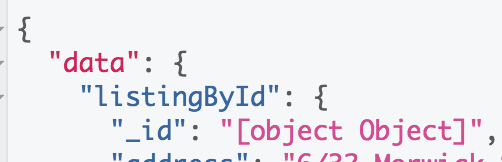
 phao5814
on 30 Sep 2018
phao5814
on 30 Sep 2018
@phao5814 that's because inside of a lambda function (one denoted by () =>) the this reference is copied from the outer closure scope. If you define it in the root scope, this ends up being the same as the global scope, i.e. process in node or window in the browser.
If you want this to work you need to say:
const { ObjectId } = mongoose.Types;
ObjectId.prototype.valueOf = function () {
return this.toString()
}
Again, you can always define a custom scalar type, as per https://github.com/apollographql/apollo-server/issues/1649#issuecomment-420840287
kgroat
on 1 Oct 2018
I get the error on a simple ...all query, as soon as I ask for _id . I did read what was here, but really not sure WHERE to fix this. I m on a minimal mongoose apollo-server-express react (cra) setup . I'm new at apollo server.. rough start .
export const GET_ALL_BLOGS = gql`
query {
getAllBlogs {
if I put _id here (client) I get the error.
title
author
body
date
}
}
`;
 axe-z
on 11 Oct 2018
axe-z
on 11 Oct 2018
Just create a virtual attribute ID convert it to string to be parse by the graphql server
Put this below in your schema file and just query for 'id'
TheSchema.virtual('id').get(function () {
return this._id.toString();
});
 davae1an
on 18 Oct 2018
davae1an
on 18 Oct 2018
@davae1an great solution!
 vctormb
on 24 Oct 2018
vctormb
on 24 Oct 2018
@Lanfei
I tried your example but still getting same error. Where do you put this code snippet? :sweat_smile: Thanks.
// If you are using mongoose:
const ObjectId = require('mongoose').Types.ObjectId;
ObjectId.prototype.valueOf = function () {
return this.toString();
};
 arvi
on 7 Nov 2018
arvi
on 7 Nov 2018
@arvi I placed that snippet of code above my schema definitions.
// ... Some more imports here...
const {
GraphQLObjectType,
GraphQLID,
GraphQLString,
GraphQLSchema,
GraphQLInt,
GraphQLList,
GraphQLFloat,
GraphQLBoolean,
} = graphql;
const { GraphQLDateTime } = graphqlDateTime;
const { ObjectId } = mongoose.Types;
ObjectId.prototype.valueOf = function () {
return this.toString();
};
const ImageType = new GraphQLObjectType({
name: "Image",
fields: () => ({
...
}),
});
// ... Some more definitions here
@phao5814, thank you so much for the hint :smile:
I put it just before the apollo server and it worked finally.
const { ObjectId } = mongoose.Types;
ObjectId.prototype.valueOf = function () {
  return this.toString();
};

const apolloServer = new ApolloServer({
  typeDefs,
  resolvers,
  context: ({ req }) => ({
    SECRET: config.secret,
  }),
  formatError(error) {
    return {
      message: error.message,
      code: error.originalError && error.originalError.code,
      locations: error.locations,
      path: error.path,
    };
  },
});

apolloServer.applyMiddleware({ app, path: '/graphql' });
app.use('/graphql', () => {});
I think that it is better to put the toString() inside of the _spread operator_. This would allow anyone who reads the code to know what is happening.
For an event model in Mongoose:
return event
.save()
.then(r => {
console.log('mongo event saved', r._doc);
return { ...r._doc, _id: event._doc._id.toString() };
})
.catch(err => {
console.error(err);
throw err;
});
This is less _generic_ but more readable.
 fireydude
on 7 Jan 2019
fireydude
on 7 Jan 2019
i'm solved the error with toString() i put the toString() inside of the schema definition
addMarket: (root, { marketName, marketLogo }) => {
return new Promise((resolve, reject) => {
const newMarket = new Market({
id: (new mongoose.Types.ObjectId()).toString(),
marketName,
marketLogo,
});
newMarket.save((err, res) => {
err ? reject(err) : resolve(res);
});
});
}
 enriqueao
on 10 Jan 2019
enriqueao
on 10 Jan 2019
I'm going to ask the same question than on #1649:
Has this problem been fixed in the meantime?
We used to do stuff like id: obj => obj._id.toHexString() in all our resolvers that handled MongoDB ObjectIds, but now it seems id: obj => obj._id alone is working perfectly fine.
 acidoxee
on 9 Jul 2019
acidoxee
on 9 Jul 2019
I get trapped in this error while populating, and the solutions above can't work for me.
Well, in my situation, I need to set a transformer to ensure Document.prototype.toJSON outputs a string instead of an object.
SampleSchema.set('toJSON', {
transform(doc, ret) {
return JSON.stringify(ret);
},
});
 EmiyaYang
on 11 Jan 2020
EmiyaYang
on 11 Jan 2020
Just create a virtual attribute ID convert it to string to be parse by the graphql server
Put this below in your schema file and just query for 'id'
TheSchema.virtual('id').get(function () {
  return this._id.toString();
});
Where exactly in the schema file? please let me know :)
 Karem1986
on 22 Dec 2020
Karem1986
on 22 Dec 2020
Related issues
 jpcbarros
·
3Comments
jpcbarros
·
3Comments
 espoal
·
3Comments
espoal
·
3Comments
 attdona
·
3Comments
attdona
·
3Comments
 stevezau
·
3Comments
stevezau
·
3Comments
 jminz
·
3Comments
jminz
·
3Comments
Most helpful comment
@phao5814, thank you so much for the hint :smile:
I put it just before the apollo server and it worked finally.