Angular-auth-oidc-client: try use setCustomRequestParameters({ 'ui_locales': culture});
Hi when i try use setCustomRequestParameters({ 'ui_locales': culture}); i don't see in fiddler my ui_locales param (any custom params )
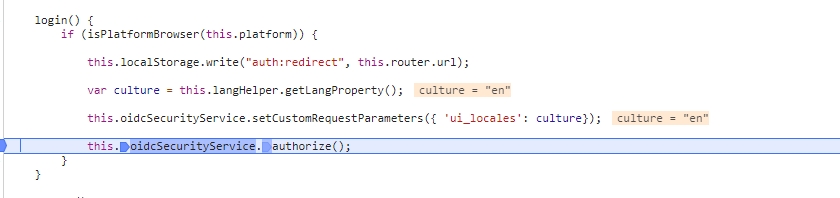
var culture = this.langHelper.getLangProperty();
this.oidcSecurityService.setCustomRequestParameters({ 'ui_locales': culture});
this.oidcSecurityService.authorize();

 andreyshiryaev
All 7 comments
Just wondering, would this help you?
https://github.com/damienbod/angular-auth-oidc-client/issues/426
 damienbod
on 13 Apr 2019
damienbod
on 13 Apr 2019
I do as in the documentation
this is get /connect/authorize http://prntscr.com/nc43j4
andreyshiryaev
on 15 Apr 2019
@andreyshiryaev I checked this, and it is getting sent in my examples. Do you still have this problem, or could you post your authorize request?
damienbod
on 26 Apr 2019
hi, i am sorry for long answer this task is low priority ....
yes i have problem yet ,
i use
"angular-auth-oidc-client": "^10.0.2",
and after this.oidcSecurityService.authorize(); i can show in output window msvs (or fiddler) request
without parameter ui_locales
http://prntscr.com/od02l4
andreyshiryaev
on 10 Jul 2019
@andreyshiryaev
You need to create a named object instead of an anonymous one - as the documentation states:
const params: any = { ui_locales: "en" };
this.oidcSecurity.setCustomRequestParameters(params);
Hope this helps.
 nybroe
on 1 Aug 2019
nybroe
on 1 Aug 2019
@nybroe are you sure? I'm trying different variants and I'm still unable to use this setCustomRequestParameters correctly.
@damienbod any help?
 rekosko
on 5 Dec 2019
rekosko
on 5 Dec 2019
@rekosko , these are the syntax' that works in our implementation:
const parameters: any = { prompt: "login" };
this.oidcSecurityService.setCustomRequestParameters(parameters);
this.oidcSecurityService.authorize();
And:
this.oidcSecurityService.setCustomRequestParameters({ prompt: "login" });
this.oidcSecurityService.authorize();
We are using the latest version 10.0.10.
You should be able to replace the prompt parameter with whatever you want to add to the request.
I hope this helps.
nybroe
on 5 Dec 2019
Related issues
 jhossy
·
4Comments
jhossy
·
4Comments
 cgatian
·
4Comments
cgatian
·
4Comments
 Expelz
·
4Comments
Expelz
·
4Comments
 vicver82
·
4Comments
vicver82
·
4Comments
 sdev95
·
3Comments
sdev95
·
3Comments
Most helpful comment
@rekosko , these are the syntax' that works in our implementation:
const parameters: any = { prompt: "login" };
this.oidcSecurityService.setCustomRequestParameters(parameters);
this.oidcSecurityService.authorize();
And:
this.oidcSecurityService.setCustomRequestParameters({ prompt: "login" });
this.oidcSecurityService.authorize();
We are using the latest version
10.0.10.You should be able to replace the
promptparameter with whatever you want to add to the request.I hope this helps.