Amplify-js: Plaintext Password Visible for 'SignUp' ONLY using USER_SRP_AUTH as CognitoUser.authenticationFlowType
Describe the bug
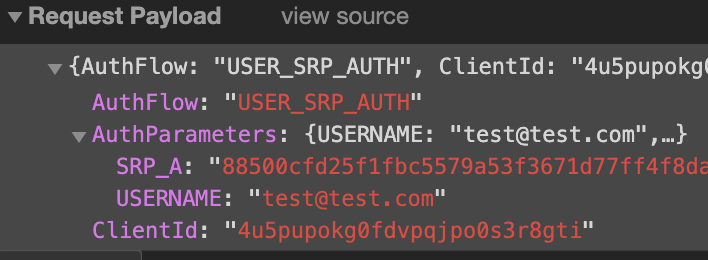
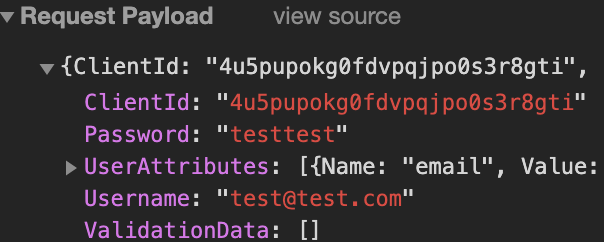
Plaintext password is visible on the client-side (web browser) when using Amplify to authenticate with Cognito for the 'SignUp' method only, the 'SignIn' method does not have this issue.
Using Chrome dev tools, when Amplify's 'SignUp' method is called, it displays the password as plaintext in the 'Password' field in the 'AuthParameters' HTTP(s) header request payload.
To Reproduce
Steps to reproduce the behavior:
_Source Code:_
- Use the 'Auth' package from 'aws-amplify'
- Call the 'signUp' method of the 'Auth' package
_UI_
- Open Chrome
- Access UI
- Use 'Inspect' feature of Chrome
- Input 'SignUp' details (username, password, etc)
- Click 'SignUp' button
- Go to 'Network' tab of the 'Inspect' panel
- Search for request accessing 'https://cognito-idp...' using 'POST' as the method
- Go to the 'Headers' tab of the request
- Scroll down to the 'Request Payload' section of the 'Headers' tab
Expected behavior
Similar to the 'SignIn' method, the 'SignUp' method should only show the SRP token, not the plaintext password, when using USER_SRP_AUTH as the auth flow type (authenticationFlowType).
Screenshots
'SignIn' use case:
'SignUp' use case:
Desktop (please complete the following information):
- OS: OS X 10.14.5
- Browser Chrome
- Version 77
Additional context
Related to Cognito auth
Sample code
auth flow type setting when cognito user is created:
https://github.com/aws-amplify/amplify-js/blob/master/packages/amazon-cognito-identity-js/src/CognitoUser.js#L94
cognito user creation inside 'SignUp' method:
https://github.com/aws-amplify/amplify-js/blob/master/packages/amazon-cognito-identity-js/src/CognitoUserPool.js#L116
 chrismcdonald0111
All 5 comments
This is a serious security issue, I have exactly the same problem!
 thinhvo0108
on 27 Sep 2019
thinhvo0108
on 27 Sep 2019
Hi @chrismcdonald0111
Thanks for creating this issue, let me share my thoughts on this
Cognito uses SRP for Authentication and passwords are not stored at all on the service
From https://en.wikipedia.org/wiki/Secure_Remote_Password_protocol
In layman's terms, during SRP (or any other PAKE protocol) authentication, one party (the "client" or "user") demonstrates to another party (the "server") that they know the password, without sending the password itself nor any other information from which the password can be derived. The password never leaves the client and is unknown to the server.
This assumes that the server had, at some point, knowledge of the "password" (or a cryptographic verifier derived from the password), SRP doesn't cover the transmission of the password or verifier to the server (the "registration"/signup step) and that's why the signUp call sends the password in clear text (so the server can generate a password verifier and store it). The protections for the signup operation (a one time operation for each user) are the ones provided in this case by the transport protocol (https, meaning communication is encrypted). All signIn operations never send the password and follow the SRP protocol.
You still get the advantage that the server doesn't know or store the password (only a verifier derived from it).
From the SRP RFC https://tools.ietf.org/html/rfc2945#section-4
SRP has been designed not only to counter the threat of casual password-sniffing, but also to prevent a determined attacker equipped with a dictionary of passwords from guessing at passwords using captured network traffic.
SRP also has the added advantage of permitting the host to store passwords in a form that is not directly useful to an attacker.
I'll dig a little bit more into this
 manueliglesias
on 27 Sep 2019
manueliglesias
on 27 Sep 2019
@manueliglesias My understanding is that the plain text password is never sent to the server in SRP. Therefore, the implementation in Amplify is incorrect.
 amzhang
on 3 Jan 2020
amzhang
on 3 Jan 2020
After some more thought, I agree with @manueliglesias.
The verifier is derived from the password in a cryptographic one-way function, but without any tunable workload parameters (such as the number of iterations in PBKDF). Therefore, if an attacker were to obtain the verifier, then brute-forcing it is pretty easy: the salt is known, the only entropy is in the password.
So sending the verifier rather than the plain password is not adding a great deal more security. It would be better to make sure the TLS tunnel is secure in the first place.
However, it would still be better to send up only the verifier and the salt since they are the minimal set of information required.
amzhang
on 3 Jan 2020
Thanks for the feedback @amzhang . Looks like @manueliglesias helped out here, so will close.
 mauerbac
on 15 Apr 2020
mauerbac
on 15 Apr 2020
Related issues
 DougWoodCDS
·
3Comments
DougWoodCDS
·
3Comments
 josoroma
·
3Comments
josoroma
·
3Comments
 rayhaanq
·
3Comments
rayhaanq
·
3Comments
 callmekatootie
·
3Comments
callmekatootie
·
3Comments
 cosmosof
·
3Comments
cosmosof
·
3Comments
Most helpful comment
Hi @chrismcdonald0111
Thanks for creating this issue, let me share my thoughts on this
Cognito uses SRP for Authentication and passwords are not stored at all on the service
From https://en.wikipedia.org/wiki/Secure_Remote_Password_protocol
This assumes that the server had, at some point, knowledge of the "password" (or a cryptographic verifier derived from the password), SRP doesn't cover the transmission of the password or verifier to the server (the "registration"/signup step) and that's why the signUp call sends the password in clear text (so the server can generate a password verifier and store it). The protections for the signup operation (a one time operation for each user) are the ones provided in this case by the transport protocol (https, meaning communication is encrypted). All signIn operations never send the password and follow the SRP protocol.
You still get the advantage that the server doesn't know or store the password (only a verifier derived from it).
From the SRP RFC https://tools.ietf.org/html/rfc2945#section-4
I'll dig a little bit more into this