Expected Behavior
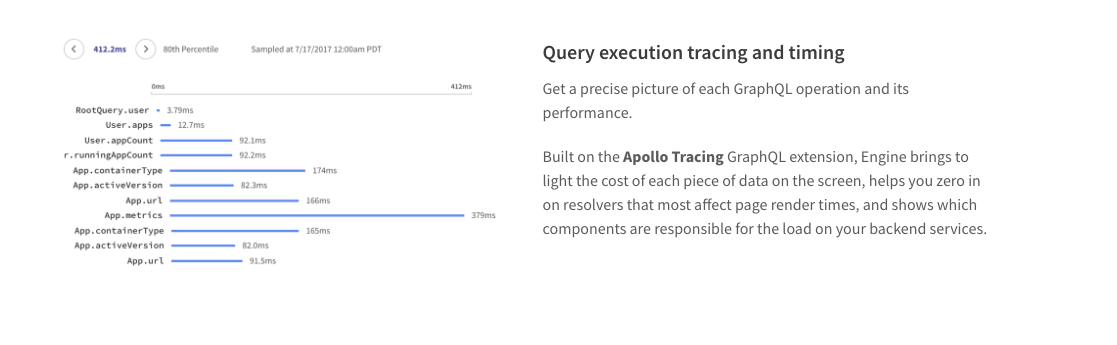
- Once a query was run that returns tracing data, parse it and display a timeline-style drilldown of the queries tracing data
Current Behavior
- New feature, not yet in the app :)
Context
- Tracing data is extremely powerful to properly debug your API and find out where potential bottlenecks are lying, especially with deeply nested structures. Integrating this into the tool itself would allow developers to be more action-aware about this and give more context about potential problems that might seem irrelevant at first but can cause serious issues in production.
 tspecht
All 23 comments
Hello @tspecht, I'll need an example of this. Unfortunately I haven't worked with tracing data in GraphQL before. I'm assuming it is related to apollo tracing? Or is it part of the GraphQL spec?
 imolorhe
on 8 Dec 2017
imolorhe
on 8 Dec 2017
Yes, exactly, sorry, should have been more clear on this, my first feature suggestion so far :)
apollo-tracing is a pretty well-established GraphQL plugin right now that runs on server side.
Small screenshot of how this is rendered in the Apollo Engine so you get an idea of what I'm talking about:
tspecht
on 8 Dec 2017
Okay. It looks like a useful feature to have when debugging servers. 👍
imolorhe
on 8 Dec 2017
https://github.com/apollographql/apollo-tracing
https://github.com/apollographql/apollo-tracing-js
https://dev-blog.apollodata.com/exposing-trace-data-for-your-graphql-server-with-apollo-tracing-97c5dd391385
https://dev-blog.apollodata.com/the-anatomy-of-a-graphql-query-6dffa9e9e747
imolorhe
on 23 Dec 2017
Yeah, that is outlining the integration basically, the visualization of the
output the plugin renders into the response data is a complete different
story unfortunately ...
On Sat, Dec 23, 2017 at 9:29 AM Samuel notifications@github.com wrote:
https://github.com/apollographql/apollo-tracing
https://github.com/apollographql/apollo-tracing-jshttps://dev-blog.apollodata.com/exposing-trace-data-for-your-graphql-server-with-apollo-tracing-97c5dd391385
https://dev-blog.apollodata.com/the-anatomy-of-a-graphql-query-6dffa9e9e747—
You are receiving this because you were mentioned.
Reply to this email directly, view it on GitHub
https://github.com/imolorhe/altair/issues/194#issuecomment-353714056,
or mute the thread
https://github.com/notifications/unsubscribe-auth/AAk0CFtXJ2VfnTLXu1YjJd_X5kscV6bZks5tDLnvgaJpZM4Q7gSs
.
tspecht
on 23 Dec 2017
Oh I know. 😄 I'm only documenting it for use when building the feature.
Requirements:
- [ ] No need to use a chart library. Regular CSS should work.
- [ ] Show (pulse) the tracing visualization button when there is tracing data available.
- [ ] Visualization viewer can be maximized.
- [ ] Add setting for showing or hiding the extensions data in the result.
imolorhe
on 23 Dec 2017
imolorhe
on 13 Jan 2018
I just want to chime in and say that this feature is what is preventing me from using altair.
Some thoughts
- Hiding the
extensions.tracingportion of the response is a great idea if you are visualizing it anyway. GraphQL Playground does this by exposing a setting, which defaults to hiding that section. - Some deeply nested queries have large tracing visualizations. Being able to pop that pane out into a separate window (or at least maximize it) would be useful in those situations.
 wraithy
on 25 May 2018
wraithy
on 25 May 2018
@wraithy Thanks for your input. Any other usability feedback regarding this would be useful. Also, is there any example project I could use to visualise and develop this feature?
@wraithy A screenshot of the tracing visualization would be nice, to give me a better picture of what you mean by large tracing visualizations. The examples I've seen are not that big.
imolorhe
on 25 May 2018
This issue has been automatically marked as stale because it has not had recent activity. It will be closed if no further activity occurs. Thank you for your contributions.
![stale[bot] picture](https://avatars3.githubusercontent.com/in/1724?v=4&s=40) stale[bot]
on 24 Jul 2018
stale[bot]
on 24 Jul 2018
Still active.
imolorhe
on 24 Jul 2018
This issue has been automatically marked as stale because it has not had recent activity. It will be closed if no further activity occurs. Thank you for your contributions.
stale[bot]
on 22 Sep 2018
.
imolorhe
on 23 Sep 2018
https://github.com/kbrandwijk/graphcool-gateway-apollo-engine-demo#advanced-example
https://github.com/apollographql/apollo-tutorial-kit/tree/server-tutorial-solution
imolorhe
on 26 Sep 2018
This issue has been automatically marked as stale because it has not had recent activity. It will be closed if no further activity occurs. Thank you for your contributions.
stale[bot]
on 25 Nov 2018
imolorhe
on 2 Dec 2018
This issue has been automatically marked as stale because it has not had recent activity. It will be closed if no further activity occurs. Thank you for your contributions.
stale[bot]
on 21 Mar 2019
unstale?
For me, this is what makes playground more useful than altair.
The first quick win, would be to just hide the "extensions" from the received json. Charts like graphql playground would be awesome, but extensions is making the payload hard to read.
If looking for a generic way, a post-request script could be useful. Just like we now have the pre-request script, but for transforming the returned json ourselves.
 smeijer
on 27 Mar 2020
smeijer
on 27 Mar 2020
When can we anticipate tracing visualization to be implemented? Looking to switch over from playground but their visualizer is very useful.
 YElyousfi
on 17 Aug 2020
YElyousfi
on 17 Aug 2020
Why has this issue been closed? Can we reopen it?
smeijer
on 19 Aug 2020
The issues get closed automatically after several months of inactivity. I can reopen the issue. If anyone is willing to pick this up, that would be awesome.
Alternatively, if there's a publicly accessible graphql server that uses the tracing visualization (or perhaps a response payload with the tracing extensions data), I could consider taking another look at this. Without that, it's difficult for me to work on this since I only know about it but haven't used it before.
imolorhe
on 19 Aug 2020
This issue has been automatically marked as stale because it has not had recent activity. It will be closed if no further activity occurs. Thank you for your contributions.
stale[bot]
on 1 Nov 2020
Ping
smeijer
on 1 Nov 2020
Related issues
 balthild
·
5Comments
balthild
·
5Comments
 MCSH
·
7Comments
imolorhe
·
3Comments
MCSH
·
7Comments
imolorhe
·
3Comments
 mike-sosa-sofarocean
·
8Comments
mike-sosa-sofarocean
·
8Comments
 razvan-jiganie-bizcuit
·
4Comments
razvan-jiganie-bizcuit
·
4Comments
Most helpful comment
unstale?
For me, this is what makes
playgroundmore useful thanaltair.The first quick win, would be to just hide the "extensions" from the received json. Charts like graphql playground would be awesome, but
extensionsis making the payload hard to read.If looking for a generic way, a
post-request scriptcould be useful. Just like we now have thepre-request script, but for transforming the returned json ourselves.