Aiohttp: Websockets not working behind Skipper reverse proxy due to Transfer-Encoding: chunked
Long story short
When running the websockets example server behind Skipper the websocket connection is dropped immediately after connect. "One or more reserved bits are on: reserved1 = 0, reserved2 = 1, reserved3 = 1"
Expected behaviour
Websocket connection is established without problems when running behind Skipper.
Actual behaviour
Websocket connection is dropped immediately after connect.
"One or more reserved bits are on: reserved1 = 0, reserved2 = 1, reserved3 = 1"
Wireshark output
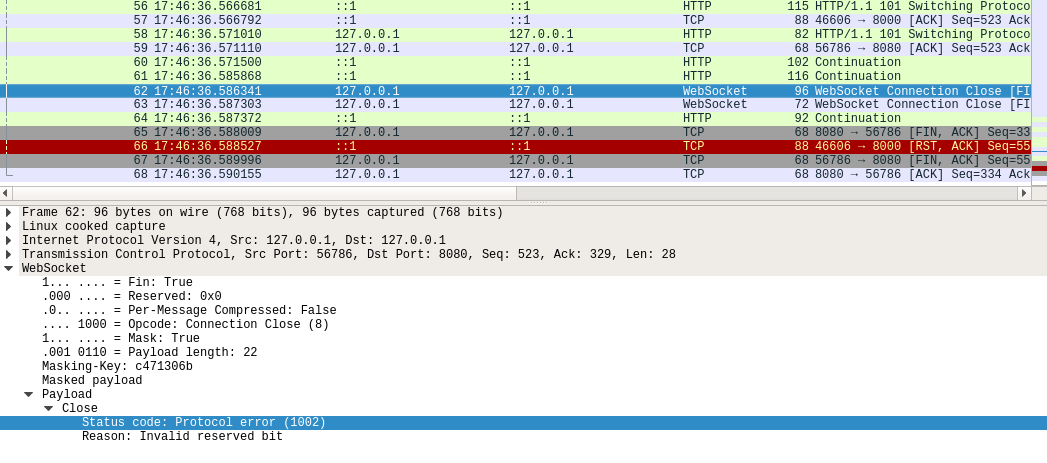
@szuecs helped to debug this issue and found that Transfer-Encoding: chunked seems to be the issue.
When i commented out the Transfer-Encoding header in:
- https://github.com/aio-libs/aiohttp/blob/master/aiohttp/web_ws.py#L182
- https://github.com/aio-libs/aiohttp/blob/master/aiohttp/web_response.py#L380
- https://github.com/aio-libs/aiohttp/blob/master/aiohttp/web_response.py#L388
The example started to work.
Question: Is Transfer encoding really necessary for websockets or could it be removed / made optional to increase compatibility with http proxy servers like Skipper?
Steps to reproduce
- Run skipper with docker (forwards 8000 to 8080):
docker run --rm -it --network host registry.opensource.zalan.do/pathfinder/skipper:v0.10.216 skipper -experimental-upgrade -experimental-upgrade-audit -application-log-level DEBUG -address :8000 -inline-routes 'r: * -> "http://127.0.0.1:8080/"'
- Run the
web_ws.pyexample - Check the logs in the Browser and Skipper console
Your environment
- Fedora Linux 29 64bit
- python 3.7.3 (also tested with python 3.6.8)
- aiohttp 3.5.4
- skipper v0.10.216
- Chrome 74.0.3729.169
This issue was initially raised @ https://github.com/miguelgrinberg/python-socketio/issues/300
 nebularazer
All 6 comments
That's interesting.
After re-reading RFC 6455 I found no Transfter-Encoding mentions.
From my understanding, it means that the protocol is chunk-neutral on WebSocket upgrading.
Looks like a minor bug in Skipper.
On the other hand, chunked-encoding is redundant.
I wrote this code but don't remember why I added the chunked encoding mode. It just works (except Skipper).
I'm open to dropping Transfer-Encoding on WebSocket handshake.
Would you provide a Pull Request?
 asvetlov
on 24 May 2019
asvetlov
on 24 May 2019
@asvetlov I am also open to change skipper code. Maybe a configuration option to disable it in aiohttp project would be good.
What I don't understand is, that after connection upgrade, we Hijack the connection and only have 2 goroutines that copy data in both directions.
For whatever reason the chunked Transfer-Encoding seems no to be working with this.
We hijack it at https://github.com/zalando/skipper/blob/master/proxy/upgrade.go#L136.
Then we start the copy goroutines https://github.com/zalando/skipper/blob/master/proxy/upgrade.go#L156-L162. The upgrade was from skipper point of view successful and logged https://github.com/zalando/skipper/blob/master/proxy/upgrade.go#L163 , in the same second we get an unexpected finished websocket session https://github.com/zalando/skipper/blob/master/proxy/proxy.go#L777.
Any ideas what the problem could be?
 szuecs
on 24 May 2019
szuecs
on 24 May 2019
I added a PR which detects websockets and does not add the chunked header.
nebularazer
on 24 May 2019
I think that support an option to switch between chunked and plain cases in WebSocket upgrade doesn't make sense for aiohttp.
It adds a burden of documenting the unused by 99% users parameter, teaching people that the parameter is not a thing to touch, support tests, etc. We need to pick the best approach and use it.
Regarding help with Skipper: sorry, I have no time to dig into the code.
Python 3.8 feature freeze is coming in a week, I've committed to delivering a bunch of new important features. Even after 3.8-beta releasing, I should dedicate my time to work on things that are important too but don't change the public API, name it bug fixing.
My wild idea is: on WebSocket hijacking you don't switch the underlying parser back to plain mode. It reads chunk length but skips the delivering these 4 bytes to upstream, which corrupts the WebSocket protocol. Or something like this.
asvetlov
on 24 May 2019
@asvetlov thanks for your input.
szuecs
on 24 May 2019
Fixed by #3800
asvetlov
on 19 Jul 2019
Related issues
 kbaston
·
3Comments
kbaston
·
3Comments
 JoseKilo
·
3Comments
JoseKilo
·
3Comments
 dcramer
·
3Comments
dcramer
·
3Comments
 Codeberg-AsGithubAlternative-buhtz
·
3Comments
Codeberg-AsGithubAlternative-buhtz
·
3Comments
 zhmiao
·
3Comments
zhmiao
·
3Comments