Aiohttp: memory leak when doing requests against AWS
Long story short
while investigating a leak in botocore (https://github.com/boto/botocore/issues/1464), I decided to check to see if this also affected aiobotocore. I found that even the get_object case was leaking in aiobotocore. So I tried doing a the underlying GET aiohttp request and found it triggers a leak in aiohttp.
Expected behaviour
no leak
Actual behaviour
leaking ~800kB over 300 requests
Steps to reproduce
update the below script with your credentials and run like so: PYTHONMALLOC=malloc
python3 `which mprof` run --interval=1 /tmp/test_leak.py -test aiohttp_test
script: https://gist.github.com/thehesiod/dc04230a5cdac70f25905d3a1cad71ce
you should get a memory usage graph like so:

Your environment
bash-4.2# /valgrind/bin/python3 -m pip freeze
aiobotocore==0.8.0
aiohttp==3.1.3
APScheduler==3.3.1
async-timeout==2.0.1
asynctest==0.12.0
attrs==18.1.0
aws-xray-sdk==1.0
botocore==1.10.12
cachetools==2.1.0
certifi==2018.4.16
chardet==3.0.4
cycler==0.10.0
datadog==0.20.0
decorator==4.3.0
dill==0.2.7.1
docutils==0.14
editdistance==0.3.1
future==0.16.0
gapic-google-cloud-pubsub-v1==0.15.4
google-api-python-client==1.6.7
google-auth==1.4.1
google-auth-httplib2==0.0.3
google-cloud-core==0.25.0
google-cloud-pubsub==0.26.0
google-gax==0.15.16
googleapis-common-protos==1.5.3
graphviz==0.8.3
grpc-google-iam-v1==0.11.4
grpcio==1.12.0
httplib2==0.11.3
idna==2.6
idna-ssl==1.0.1
iso8601==0.1.12
jmespath==0.9.3
jsonpickle==0.9.6
kiwisolver==1.0.1
matplotlib==2.2.2
memory-profiler==0.52.0
multidict==4.3.1
nameparser==0.5.6
numpy==1.14.3
oauth2client==4.1.2
objgraph==3.4.0
packaging==17.1
ply==3.8
proto-google-cloud-pubsub-v1==0.15.4
protobuf==3.5.2.post1
psutil==5.4.5
pyasn1==0.4.2
pyasn1-modules==0.2.1
PyGithub==1.39
PyJWT==1.6.1
pyparsing==2.2.0
python-dateutil==2.7.3
pytz==2018.4
requests==2.18.4
rsa==3.4.2
setproctitle==1.1.10
simplejson==3.15.0
six==1.11.0
tzlocal==1.5.1
uritemplate==3.0.0
urllib3==1.22
wrapt==1.10.11
yarl==1.2.4
 thehesiod
All 32 comments
Could you run with https://docs.python.org/3/library/tracemalloc.html enabled?
What objects are leaking?
 asvetlov
on 18 May 2018
asvetlov
on 18 May 2018
I've been trying to, but I ran into: https://bugs.python.org/issue33565 :( You wouldn't believe the pain I've had trying to diagnose several leaks in our application.
thehesiod
on 18 May 2018
Python version? Have you tried with older Aiohttp releases?
 pfreixes
on 18 May 2018
pfreixes
on 18 May 2018
3.6.5, 2.3.10 is the same
thehesiod
on 18 May 2018
FYI: looks like the warnings fix does not solve the leak (entirely)
thehesiod
on 23 May 2018
Ok after getting the warnings fix, no significant leaks are detected by tracemalloc however memory is definitely increasing. I'm guessing a third party library is leaking like openssl.
memory usage graph generated (w/o tracemalloc usage of course):

thehesiod
on 24 May 2018
similarly objgraph is not showing any issues
thehesiod
on 24 May 2018
I've updated my script and I think I have a testcase against raw asyncio sockets, re-validating now.
thehesiod
on 24 May 2018
@asvetlov I've updated my test script per the gist link above which allows you to run w/ memory_profiler or tracemalloc, I've created tests for botocore/aiobotocore/aiohttp and asyncio (see -test param)
botocore no longer leaks with the warnings fix, however aiohttp still leaks.
I tried creating a raw asyncio http client based on aiohttp's implementation but have been unable to reproduce the leak with it. If you run the script w/ tracemalloc you'll see it does not report any leaks, nor does objgraph. So it sounds like there's a native leak somewhere.
Any idea how to get the leak to reproduce with the native asyncio client in my script, or even better what the leak is?
thehesiod
on 24 May 2018
No idea yet :(
asvetlov
on 24 May 2018
btw this may be unrelated but in a separate project I noticed that simply using PYTHONMALLOC=malloc caused a leak to disappear
thehesiod
on 13 Jul 2018
I believe I may be running into this same issue. I'm running into massive memory leaks doing SSL requests. tracemalloc, mem_top, and friends don't report anything that odd. If anything, the number of objects and memory used by them seem to decrease as actual memory usage increases.
EDIT: For clarity, I want to mention that I'm not using aiobotocore, just straight aiohttp, and I'm not interacting with AWS.
 evanfoster
on 17 Sep 2018
evanfoster
on 17 Sep 2018
Well, I was able to fix my issue.
It was as simple as this:
connector = aiohttp.TCPConnector(enable_cleanup_closed=True)
session = aiohttp.ClientSession(connector=connector)
The webserver I'm hitting must have a broken SSL implementation. Dunno if this would fix the issue that @thehesiod is having, however.
evanfoster
on 17 Sep 2018
Some additional information that may be related to this issue:
I'm having a large memory leak trying to upload binary files (video) to AWS S3.
I've done several tests and I can confirm that memory leak is caused by calling aiobotocore.s3.put_object. What is interesting is memory usage that I have after running a test case:
- Case 1 - 100 files uploaded, File size - 2 Mb, Test is over and I measure resident memory:
Memory before GC - 297052
Memory after GC - 215856 - Case 2 - 100 files uploaded, File size - 20 Mb, Test is over and I measure resident memory:
Memory before GC - 1.977g
Memory after GC - 98452
The same processing without saving files to S3 have a resulting memory footprint around ~80Mb And GC doesn't change it much.
Cause of this I have 2 basic assumptions:
1) Some native code messes up reference count for byte-arrays preventing them from being released properly.
2) memory leak size is somehow related to the size of the files being processed (calculation of file size, hash, etc.). For some reason resulting memory leak is much smaller for big files (since they don't fit in buffer or some other reason).
I will try to investigate this issue deeper to find out how exactly file contents is processed and what may cause this issues.
 Alexei-Kornienko
on 18 Sep 2018
Alexei-Kornienko
on 18 Sep 2018
enable_cleanup_closed=True
Doesn't work in my case :(
Alexei-Kornienko
on 18 Sep 2018
updated my test script with some new options, and ran with python3.7 (to avoid warning leak) with:
aiobotocore        0.9.4
aiodns             1.1.1
aiohttp            3.3.2.1
async-timeout      3.0.0
attrs              18.1.0
awscli             1.15.59
boto3              1.7.58
botocore           1.10.58
cchardet           2.1.1
certifi            2018.4.16
chardet            3.0.4
colorama           0.3.9
datadog            0.22.0
decorator          4.3.0
docutils           0.14
entrypoints        0.2.3
graphviz           0.9
idna               2.7
jmespath           0.9.3
kiwisolver         1.0.1
memory-profiler    0.54.0
msgpack-python     0.5.6
multidict          4.3.1
nameparser         0.5.7
objgraph           3.4.0
packaging          17.1
pip                18.0
psutil             5.4.6
pyasn1             0.4.4
pycares            2.3.0
PyGithub           1.40
PyJWT              1.6.4
pyparsing          2.2.0
Pypubsub           4.0.0
python-dateutil    2.7.3
python-json-logger 0.1.9
PyYAML             3.13
requests           2.19.1
rsa                3.4.2
schema             0.6.8
setuptools         39.0.1
simplejson         3.16.0
six                1.11.0
ujson              1.35
urllib3            1.23
wrapt              1.10.11
wxPython           4.0.3
yarl               1.2.6
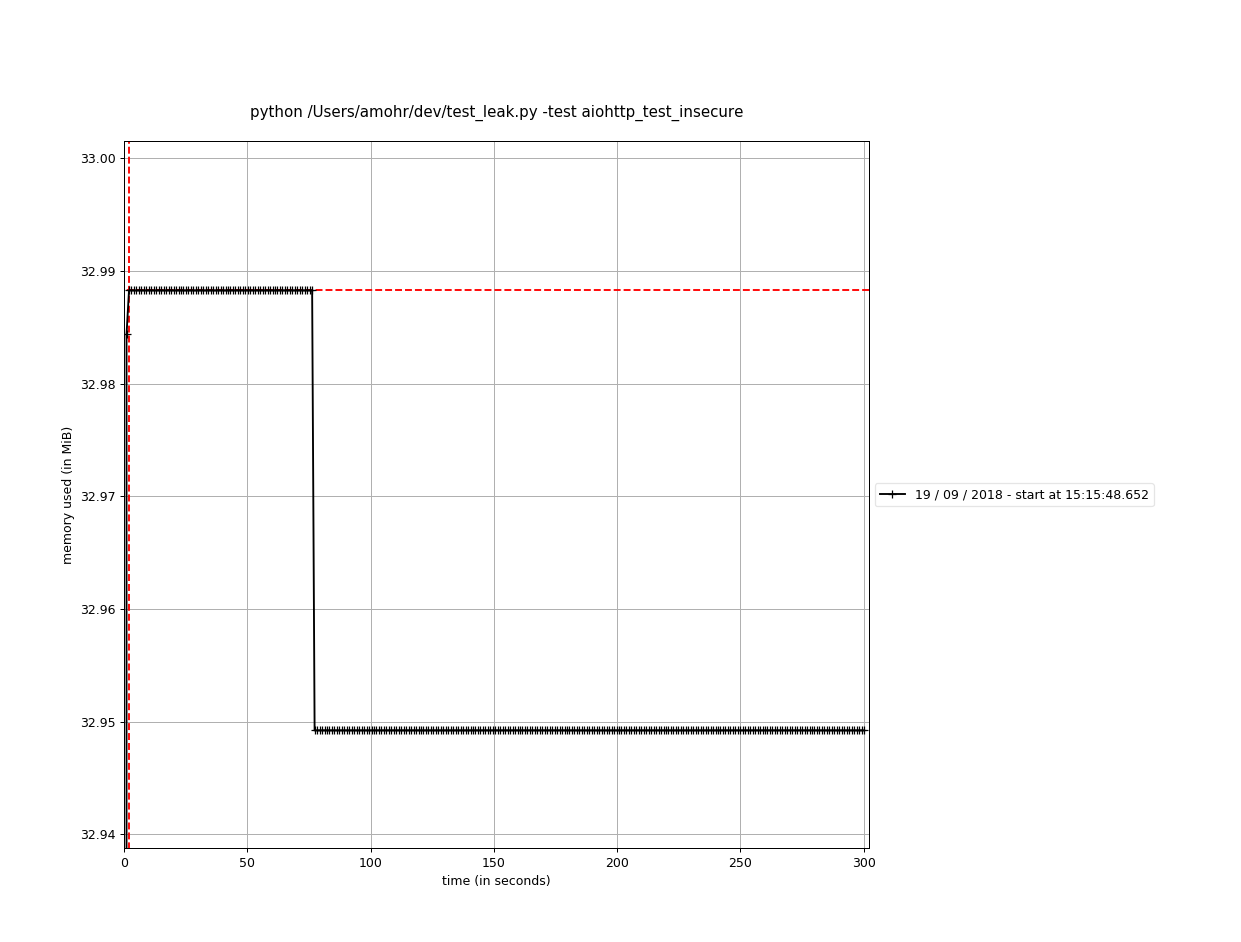
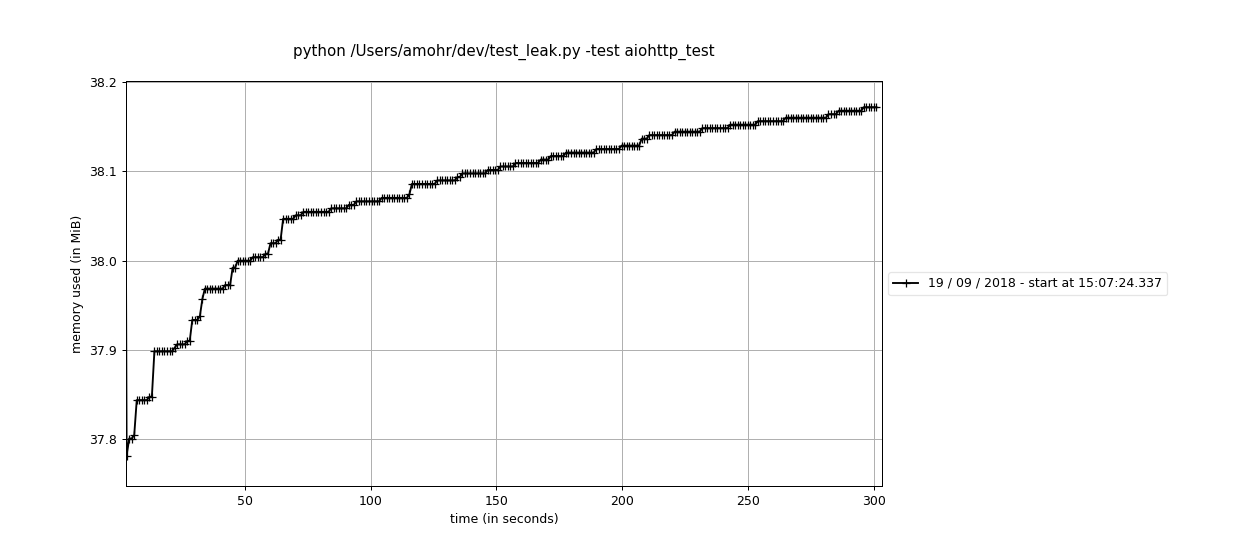

so this seems to definitely be an SSL related leak
thehesiod
on 20 Sep 2018
FYI:
>>> ssl.OPENSSL_VERSION
'OpenSSL 1.0.2o  27 Mar 2018'
another interesting note is that I had to add a test limiter to the insecure test because it's SOOO much faster than the https test, so some serious https optimization is needed
thehesiod
on 20 Sep 2018
Do You use uvloop? If yes, which version?
 hellysmile
on 20 Sep 2018
hellysmile
on 20 Sep 2018
@hellysmile me? no, just regular asyncio loop, you can see in my gist link above
thehesiod
on 20 Sep 2018
ok, looks like I'm now able to reproduce the leak with my raw asyncio socket test, see:
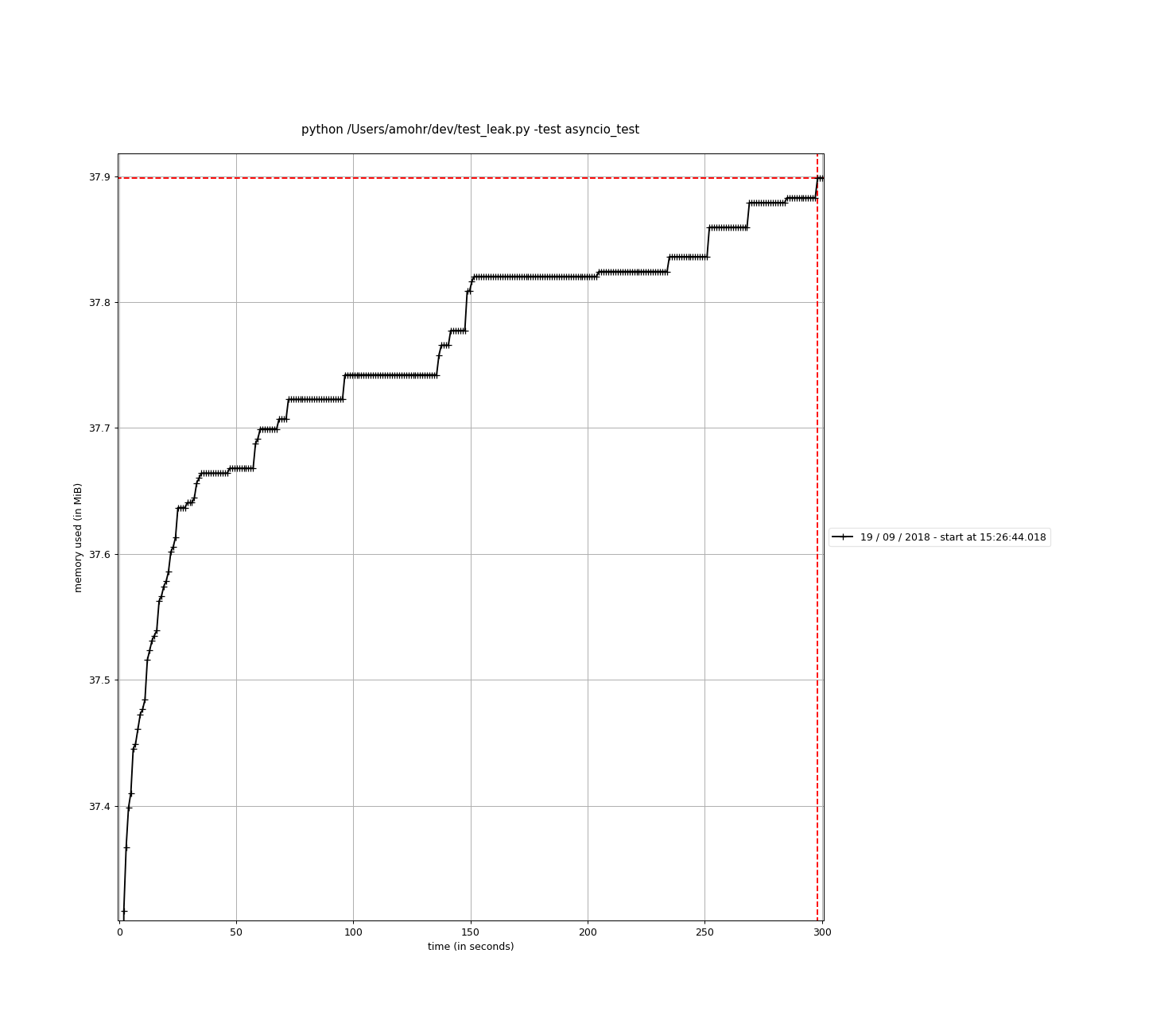
logged python bug: https://bugs.python.org/issue34745
thehesiod
on 20 Sep 2018
@thehesiod what about to try with uvloop?
hellysmile
on 20 Sep 2018
@hellysmile updated gist with uvloop support, still leaks w/ uvloop

thehesiod
on 20 Sep 2018
Not sure if I hit the wide side of the barn with it, but recently I was tracing memory leak in aiohttp app and came to this: https://github.com/aio-libs/multidict/issues/307
For some reason latest aiohttp still depends on a buggy version. Upgrading multidict fixed the issue for me.
 whale2
on 3 Dec 2018
whale2
on 3 Dec 2018
@whale2 multidict memleak is not related to the issue: it was introduced by multidict 4.5.0 (2018-11-19) and finally fixed by 4.5.2 (2018-11-28).
@thehesiod used older multidict version for his measurements.
asvetlov
on 3 Dec 2018
ya, plus I was able to repro with raw asyncio sockets per my cmt above
thehesiod
on 3 Dec 2018
looks like a fix has been proposed in https://bugs.python.org/issue34745! When I get a change I need to try it, if or anyone else gets a chance!
thehesiod
on 23 Mar 2019
@thehesiod the graph in https://github.com/python/cpython/pull/12386 is the result of a slightly simplified version of your gist, would that do?
 fantix
on 25 Mar 2019
fantix
on 25 Mar 2019
thanks @fantix , just ran my test w/ the aiohttp_test scenario with a build based on your PR (and a ported warnings fix for 3.6) and got the below graph, you rock! So happy I'm going to port this to our prod instances tonight! :)
closing this issue! ty!

thehesiod
on 25 Mar 2019
Glad it works for you!
fantix
on 25 Mar 2019
@fantix looking at the new graph again, what's a little worrying is that memory is still increasing, however much slower. Definitely lower priority from original issue
thehesiod
on 25 Mar 2019
@thehesiod yeah, I feel you. I think we should have more of the same refcount-only tests like gevent to guarantee the core of asyncio or uvloop (maybe aiohttp too, didn't check) does not produce circular references.
fantix
on 25 Mar 2019
Related issues
asvetlov
·
42Comments
 fafhrd91
·
29Comments
fafhrd91
·
29Comments
 K900
·
31Comments
asvetlov
·
36Comments
K900
·
31Comments
asvetlov
·
36Comments
 omnicognate
·
34Comments
omnicognate
·
34Comments