30-seconds-of-code: Testing
Since @kingdavidmartins implemented testing 🔥 , it was our task to write test cases for each snippet. 🚒
Today I wrote a bunch of test cases for snippets that aren't complicated in terms of the test environment (need to run in browser etc.). While doing so I've found few problems associated with testing. One of them being:
[BUG] Problems with functions that use recursion:
The list of broken functions: gcd, factorial, elo, recursive, deepFlatten, curry, cleanObj, anagrams (I probably missed some of them).
Here is an explanation for gcd and why does it not work:
The current structure of folder in which test is written:
gcd.js tile:
module.exports = (...arr) => {
const _gcd = (x, y) => (!y ? x : _gcd(y, x % y));
return [...arr].reduce((a, b) => _gcd(a, b));
};
and gcd.test.js file:
const test = require('tape');
const gcd = require('./gcd.js');

test('Testing gcd', (t) => {
    t.equal(gcd(8, 36), 4, "Calculates the greatest common divis...");
    t.end();
});
In the case mentioned above, the test fails because gcd is not defined in gcd.js. The same happens with every other function that uses recursion. We have to figure out how to solve this problem.
the other problem is much easier one
[BUG] Some snippets repeat with different names:
I've found some snippets share nearly the same functionality, and I think we should squash them into one snippet. For example: deepFlatten, flatten and flattenDepth all do nearly the same thing, so we could squash them into one more useful snippet.
 fejes713
All 16 comments
As far as recursion goes, I think we should leave the module/JS file generation to the module script and let tdd only create new files for snippet tests that do not exist. That way we deal with the issue once and for all.
As far as merging snippets is considered, so far we have followed lodash's implementation and this has caused a few missteps. This should be a new issue to discuss what our golden rule is about where we split a snippet into two. For example flatten and flattenDepth are essentially the same (if you have a default parameter for depth=1 in the second one, they are the exact same). But deepFlatten goes on forever and is implemented slightly differently. So, my opinion is 2/3 of these could be merged. This is a highly complicated issue, as each snippet is different. Let's open an ongoing discussion about these and update guidelines.
 Chalarangelo
on 10 Jan 2018
Chalarangelo
on 10 Jan 2018
@fejes713 Nice Catch!! 💯 pushing simple fix.
@Chalarangelo I honestly don't think it's necessary all that needs to be added is snippetName declaration.
Which would look like this
module.exports = gcd = (...arr) => {
const _gcd = (x, y) => (!y ? x : gcd(y, x % y));
return [...arr].reduce((a, b) => _gcd(a, b));
};
instead of this
module.exports = (...arr) => {
const _gcd = (x, y) => (!y ? x : gcd(y, x % y));
return [...arr].reduce((a, b) => _gcd(a, b));
};
 kingdavidmartins
on 10 Jan 2018
kingdavidmartins
on 10 Jan 2018
Now your/our test @fejes713 and all the like passes!! 😄
kingdavidmartins
on 10 Jan 2018
For example flatten and flattenDepth are essentially the same (if you have a default parameter for depth=1 in the second one, they are the exact same). But deepFlatten goes on forever and is implemented slightly differently. So, my opinion is 2/3 of these could be merged.
@Chalarangelo I agree. I vote for the removal of flatten
kingdavidmartins
on 10 Jan 2018
@kingdavidmartins @Chalarangelo me too!
fejes713
on 10 Jan 2018
I'll deal with flatten tomorrow then, if nobody else PRs it.
Closing as resolved in #528. Thanks for the quick fix @kingdavidmartins!
Chalarangelo
on 10 Jan 2018
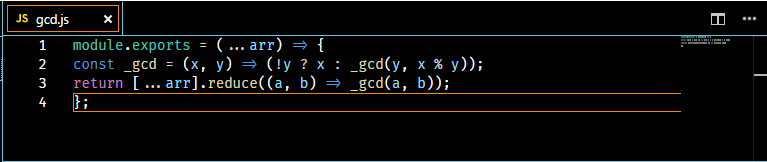
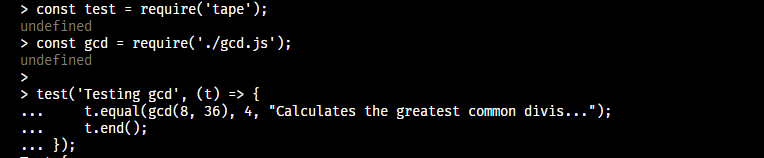
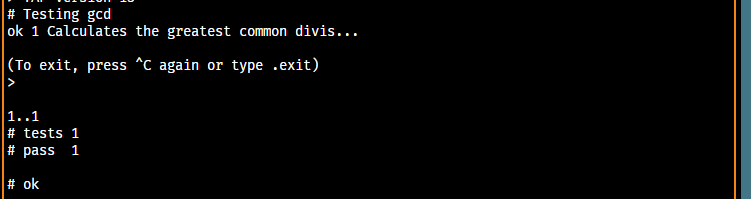
That test is valid under nodejs. Tested it in repl
 skatcat31
on 11 Jan 2018
skatcat31
on 11 Jan 2018
I guess I'm confused in what the issue you ran into was?
skatcat31
on 11 Jan 2018
@skatcat31 one of the gcd did not have an underscore prefix (the OP mistakenly listed it as having one). So it needs to have the name of the function (gcd with no prefix) in order to work
 atomiks
on 11 Jan 2018
atomiks
on 11 Jan 2018
Then for testing listing it as a global is perfectly fine since it's a test environment. However my personal preference would be to make it a local variable to then be made the export on a line below so as to not mutate the global. The fact that we're mutating the snippet structure instead of merely adding a line with the snippet name might be due to the pattern matching though. @kingdavidmartins how hard would it be to transition to this instead of the global method?
const gcd = (...arr) => {
const _gcd = (x, y) => (!y ? x : _gcd(y, x % y));
return [...arr].reduce((a, b) => _gcd(a, b));
};
module.exports = gcd
@skatcat31 That's not a bad idea and looks a bit cleaner. I think we could do that.
On a side note, I never closed the issue and I haven't yet updated flatten to work with a depth, I will do that in a little bit.
Chalarangelo
on 11 Jan 2018
@Chalarangelo I am doing flatten on a new branch flatten-fix
fejes713
on 11 Jan 2018
@fejes713 Alright, I'd suggest we call the updated merged function flatten instead of flattenDepth but essentially keep flattenDepth's functionality with a default depth of 1, so that without a second argument it's a normal flatten.
Chalarangelo
on 11 Jan 2018
Okay, gotcha. Expect PR soon
fejes713
on 11 Jan 2018
@skatcat31 Just to confirm is there really any benefit to go with your suggested route which is the following. In case I miss something
const gcd = (...arr) => {
const _gcd = (x, y) => (!y ? x : gcd(y, x % y));
return [...arr].reduce((a, b) => _gcd(a, b));
};
module.exports = gcd
When compared to the following
module.exports = gcd = (...arr) => {
const _gcd = (x, y) => (!y ? x : gcd(y, x % y));
return [...arr].reduce((a, b) => _gcd(a, b));
};
Since the way snippetName.js is set up. No other methods or code should or would implement/add to the file since it will & only contain the snippets code that we need to export.
Like you said
Testing listing it as a global is perfectly fine since it's a test environment. However my personal preference would be to make it a local variable to then be made the export on a line below so as to not mutate the global.
Updating it to do the following
const gcd = (...arr) => {
const _gcd = (x, y) => (!y ? x : gcd(y, x % y));
return [...arr].reduce((a, b) => _gcd(a, b));
};
module.exports = gcd
Honestly wouldn't be hard, however what's the point to change it if it boils down to personal preference and no real added benefit
kingdavidmartins
on 11 Jan 2018
This thread has been automatically locked since there has not been any recent activity after it was closed. Please open a new issue for any follow-up tasks.
![lock[bot] picture](https://avatars1.githubusercontent.com/in/6672?v=4&s=40) lock[bot]
on 18 Dec 2019
lock[bot]
on 18 Dec 2019
Related issues
 Lucien-X
·
5Comments
Lucien-X
·
5Comments
 GrosSacASac
·
3Comments
GrosSacASac
·
3Comments
 YusofBandar
·
5Comments
kingdavidmartins
·
5Comments
YusofBandar
·
5Comments
kingdavidmartins
·
5Comments
 larrybotha
·
3Comments
larrybotha
·
3Comments
Most helpful comment
As far as recursion goes, I think we should leave the module/JS file generation to the
modulescript and let tdd only create new files for snippet tests that do not exist. That way we deal with the issue once and for all.As far as merging snippets is considered, so far we have followed lodash's implementation and this has caused a few missteps. This should be a new issue to discuss what our golden rule is about where we split a snippet into two. For example
flattenandflattenDepthare essentially the same (if you have a default parameter fordepth=1in the second one, they are the exact same). ButdeepFlattengoes on forever and is implemented slightly differently. So, my opinion is 2/3 of these could be merged. This is a highly complicated issue, as each snippet is different. Let's open an ongoing discussion about these and update guidelines.